Mitochondrial peptide

SS-31 (10 mg vial) dosage protocol

Dosage chart, U-100 syringe units and supplies for a 10 mg vial of SS-31 mixed with 1 mL. For the full research summary, see the SS-31 page.

01

SS-31 quick reference (10 mg vial)

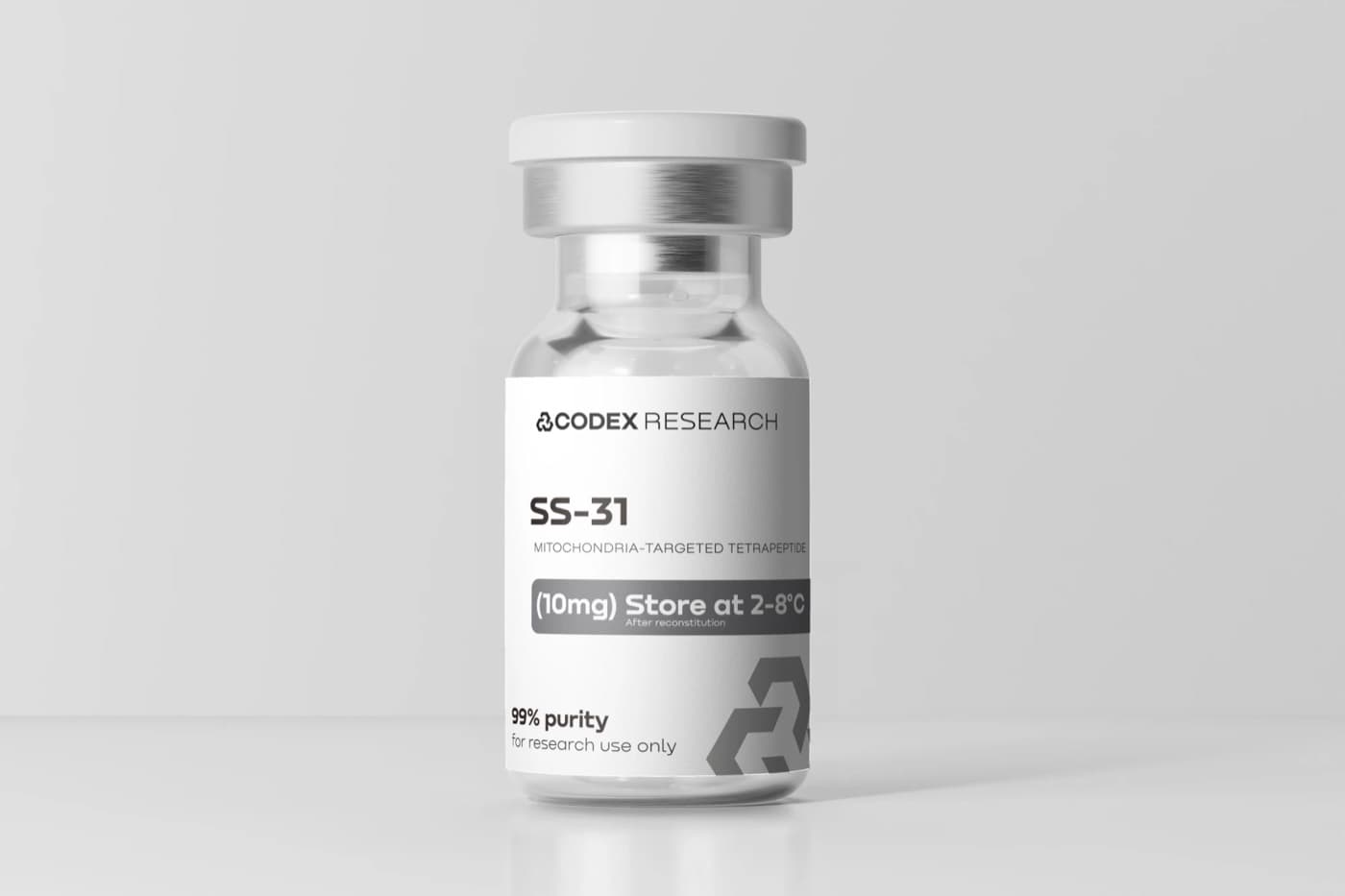
Vial contents
10 mg SS-31
Final volume
1 mL
Concentration
10 mg/mL
One U-100 unit
100 mcg in 0.01 mL
02

SS-31 dosage chart

Amounts as reported for this peptide, with the syringe measure for this vial. Reported use is not evidence that a schedule works or is safe, and none of this is medical advice.

Standard, once daily

  • Subcutaneous injection, once a day
  • Community-reported

Reported in the research community. It has not been tested as a schedule in human trials. Worked out with a 10 mg vial + 1 mL bacteriostatic water (10 mg/mL, 100 mcg per unit).

Amounts as reported, with the syringe or spray measure for the vial below. Not a recommendation.
PeriodAmount each timeU-100 unitsVolume
Weeks 1-25 mg500.5 mL
Week 3 on10 mg1001 mL

Higher, once daily

  • Subcutaneous injection, once a day
  • Community-reported

Reported in the research community. It has not been tested as a schedule in human trials. Worked out with a 10 mg vial + 1 mL bacteriostatic water (10 mg/mL, 100 mcg per unit).

Amounts as reported, with the syringe or spray measure for the vial below. Not a recommendation.
PeriodAmount each timeU-100 unitsVolume
Weeks 1-25 mg500.5 mL
Weeks 3-410 mg1001 mL
Weeks 5-815 mg2 injections of 75 units1.5 mL
Week 9 on20 mg2 injections of 100 units2 mL

Reconstitution steps

  1. Draw 1 mL of bacteriostatic water with a sterile syringe.
  2. Inject it slowly down the inside wall of the vial, not onto the powder, to avoid foaming.
  3. Swirl or roll the vial gently until the powder dissolves. Do not shake it.
  4. Label it with the date and the volume of water, and refrigerate at 2-8 °C (36-46 °F), away from light.
03

Supplies needed

Minimum supplies for each length of the schedule above, with 10 mg vials and 1 mL of water per vial. One new syringe per injection (two if over 1 mL), two alcohol swabs per injection, 10 mL water bottles.

Standard, once daily

  • Subcutaneous injection, once a day
  • Community-reported
Minimum supplies, worked out from the amounts above. Add a margin for losses.
Item8 weeks12 weeks
Injections5684
Total peptide490 mg770 mg
SS-31 vials (10 mg)4977
Bacteriostatic water49 mL77 mL
Water bottles (10 mL)58
U-100 insulin syringes5684
Alcohol swabs (boxes of 100)112 (2)168 (2)

Higher, once daily

  • Subcutaneous injection, once a day
  • Community-reported
Minimum supplies, worked out from the amounts above. Add a margin for losses.
Item8 weeks12 weeks
Injections5684
Total peptide630 mg1,190 mg
SS-31 vials (10 mg)63119
Bacteriostatic water63 mL119 mL
Water bottles (10 mL)712
U-100 insulin syringes84140
Alcohol swabs (boxes of 100)168 (2)280 (3)

Research supplier

For laboratory research use only.

Codex Research LabShips from Panama City · US domestic shipping

04

Peptide reconstitution

Try other volumes of water: the concentration and the units per amount change with it.

Reconstitution calculator

Arithmetic only. It assumes the vial holds exactly what the label says.

Concentration
10,000 mcg/mL
Per U-100 unit
100 mcg
Volume for your amount
—
Concentration of a 10 mg vial after adding the liquid, and peptide per U-100 unit (0.01 mL).
Liquid addedConcentrationPer unit
1 mL10,000 mcg/mL100 mcg
2 mL5,000 mcg/mL50 mcg
3 mL3,333 mcg/mL33.3 mcg
05

SS-31 vial and research context

  • Reconstitute: add 1 mL of bacteriostatic water for a 10 mg/mL solution.
  • Amounts in the chart: 5 mg-20 mg each time, by subcutaneous injection, once a day.
  • Easy measuring: at 10 mg/mL, one unit (0.01 mL) on a U-100 insulin syringe holds about 100 mcg.
  • Storage: freeze-dried, keep it sealed, cold and away from light (frozen for long storage). Once mixed, refrigerate at 2-8 °C and avoid freezing and thawing.

SS-31 is a four-amino-acid peptide that binds cardiolipin in the inner membrane of mitochondria. As elamipretide (Forzinity), it received FDA accelerated approval in September 2025 for Barth syndrome, while trials in other conditions have mostly missed their main goals.

06

SS-31 10 mg protocol overview

  • Primary calculation: 10 mg made up to 1 mL equals 10 mg/mL.
  • Amounts shown: 5 mg-20 mg per administration. Reported in the research community. It has not been tested as a schedule in human trials.
  • Route and frequency: subcutaneous injection, once a day.
  • Evidence ceiling: 10 of the 12 studies with a dose in our library were done in people.
  • Regulatory status: Accelerated approval as Forzinity (elamipretide) for Barth syndrome in patients weighing at least 30 kg, pending a confirmatory trial. Research products are not the approved drug.
  • Approved drug: the prescription drug has its own dosing in its FDA label. See the label dosing.
07

How to read the SS-31 dosage chart

A 10 mg vial holds 10,000 mcg of SS-31. Adding 1 mL gives 10 mg/mL, so one U-100 unit (0.01 mL) holds 100 mcg. To get the units for an amount, divide it by 100 mcg. The units are a volume mark on the syringe, not a measure of potency.

  • 5 mg: 0.5 mL, or 50 U-100 units.
  • 10 mg: 1 mL, or 100 U-100 units.
  • 15 mg: 1.5 mL, or 150 U-100 units, more than one 1 mL syringe (2 injections).
  • 20 mg: 2 mL, or 200 U-100 units, more than one 1 mL syringe (2 injections).

Vial coverage by mass: 2 full amounts of 5 mg, 1 full amounts of 10 mg, 0 full amounts of 15 mg, 0 full amounts of 20 mg per vial, before any handling loss.

If a different volume of water is used, every unit figure changes: recalculate with the calculator above.

08

Human SS-31 dosage evidence

Elamipretide has a real human trial record, mostly sponsored by its developer. Results by condition:

  • Barth syndrome: in a 12-person placebo-controlled crossover trial, neither main goal was met (Thompson 2021). In the open-label extension, walking distance and knee muscle strength improved and stayed better up to 168 weeks in 8 people (Thompson 2024), and treated patients did better than untreated patients from records (Hornby 2022). These uncontrolled results underpin the accelerated approval.
  • Primary mitochondrial myopathy: a short intravenous trial suggested longer walking distance at the highest dose (Karaa 2018), and a 4-week crossover showed better self-reported fatigue but missed its main goal (Karaa 2020). The 218-person phase 3 trial MMPOWER-3 found no difference from placebo (Karaa 2023).
  • Heart failure: a single infusion slightly reduced heart volumes at the highest dose (Daubert 2017), but four weeks of daily injections did not change heart volume or function (Butler 2020).
  • Heart attack: given during stenting, it did not reduce heart muscle damage (Gibson 2016).
  • Dry macular degeneration: a 48-week trial missed both main goals, with some favourable secondary imaging findings (Ehlers 2025).

In short: elamipretide is generally well tolerated in trials, with injection-site reactions as the main side effect. Benefit has been suggested only in Barth syndrome, from very small and largely uncontrolled data, and has not been shown in the other conditions tested.

Doses used in human studies

  • Reid Thompson W 2021: 40 mg per day (Subcutaneous, once daily; 12 weeks on each arm of a crossover (4-week washout), then an open-label extension)
  • Thompson WR 2024: 40 mg daily (Subcutaneous, once daily; 168 weeks)
  • Hornby B 2022: 40 mg daily (TAZPOWER extension patients)
  • Karaa A 2018: 0.01, 0.1 or 0.25 mg/kg/h, or placebo (Intravenous infusion over 2 hours; 5 days)
  • Karaa A 2020: 40 mg/day (Subcutaneous, once daily; 4 weeks on each arm, with a 4-week washout)
  • Karaa A 2023: 40 mg/d (Subcutaneous, once daily; 24 weeks)
  • Daubert MA 2017: 0.005, 0.05 or 0.25 mg/kg/h, or placebo (Intravenous, single 4-hour infusion; Single infusion, follow-up 24 hours)
  • Butler J 2020: 4 mg or 40 mg once daily, or placebo (Subcutaneous, once daily; 28 days)
  • Gibson CM 2016: 0.05 mg/kg/h for 1 hour (Intravenous infusion; Single infusion around the time of coronary stenting)
  • Ehlers JP 2025: 40 mg daily (Subcutaneous, once daily; 48 weeks, plus 4 weeks of follow-up)

Every study dose, including animal and cell studies, is in the SS-31 dose table.

09

SS-31 safety, side effects and evidence limits

Because elamipretide has been through clinical trials, its side effects in people are better described than for most peptides. Injection-site reactions (redness, pain, itching, hardening, bruising) were the most common, affecting most people in trials (Karaa 2020; Thompson 2024). The FDA label also lists a temporary rise in eosinophils (a type of white blood cell), hypersensitivity, and a warning about the preservative benzyl alcohol in newborns.

  • Approved drug vs research product: the approved product is made to regulated standards for one disease. Products sold as "SS-31" online are not checked for identity, purity, dose or sterility, and the trial safety data do not apply to them.
  • Kidney function: the drug is cleared by the kidneys, and the label calls for a lower dose in severe kidney impairment.
  • Limited evidence of benefit: outside Barth syndrome, larger trials did not show a benefit.
  • Injection risks: any injected product that is not sterile can cause infection or abscesses.
  • FDA: Accelerated approval as Forzinity (elamipretide) for Barth syndrome in patients weighing at least 30 kg, pending a confirmatory trial. Research products are not the approved drug.
  • Evidence limits: reported use is not evidence that a schedule works or is safe. Animal doses do not convert to people, and research products are not made or checked for use in people.
  • Status checked on: Oct 26, 2026.
10

Questions about the SS-31 10 mg vial

How much bacteriostatic water goes into a 10 mg SS-31 vial?

There is no single correct volume: it only changes the concentration. For a 10 mg vial, 1 mL gives 10,000 mcg/mL, 2 mL gives 5,000 mcg/mL, 3 mL gives 3,333 mcg/mL. More water makes small amounts easier to measure; less water keeps volumes small. Whatever volume is used, write it on the label.

What does one unit on an insulin syringe mean?

On a U-100 syringe, 100 units = 1 mL, so one unit is 0.01 mL. How much peptide that holds depends on the concentration of the vial, which depends on how much water was added.

Can doses from animal studies of SS-31 be converted to people?

No. Animal doses are reported per kilogram for a different species, and scaling them to people is not reliable. That is why Upzo shows each study dose next to its study, unconverted.

Research and education only. Not medical advice. Many peptides on this site are not approved by the FDA for human use. Doses shown are the ones used in published studies and are not a recommendation. Talk to a licensed clinician before using any of them. Read the full disclaimer.