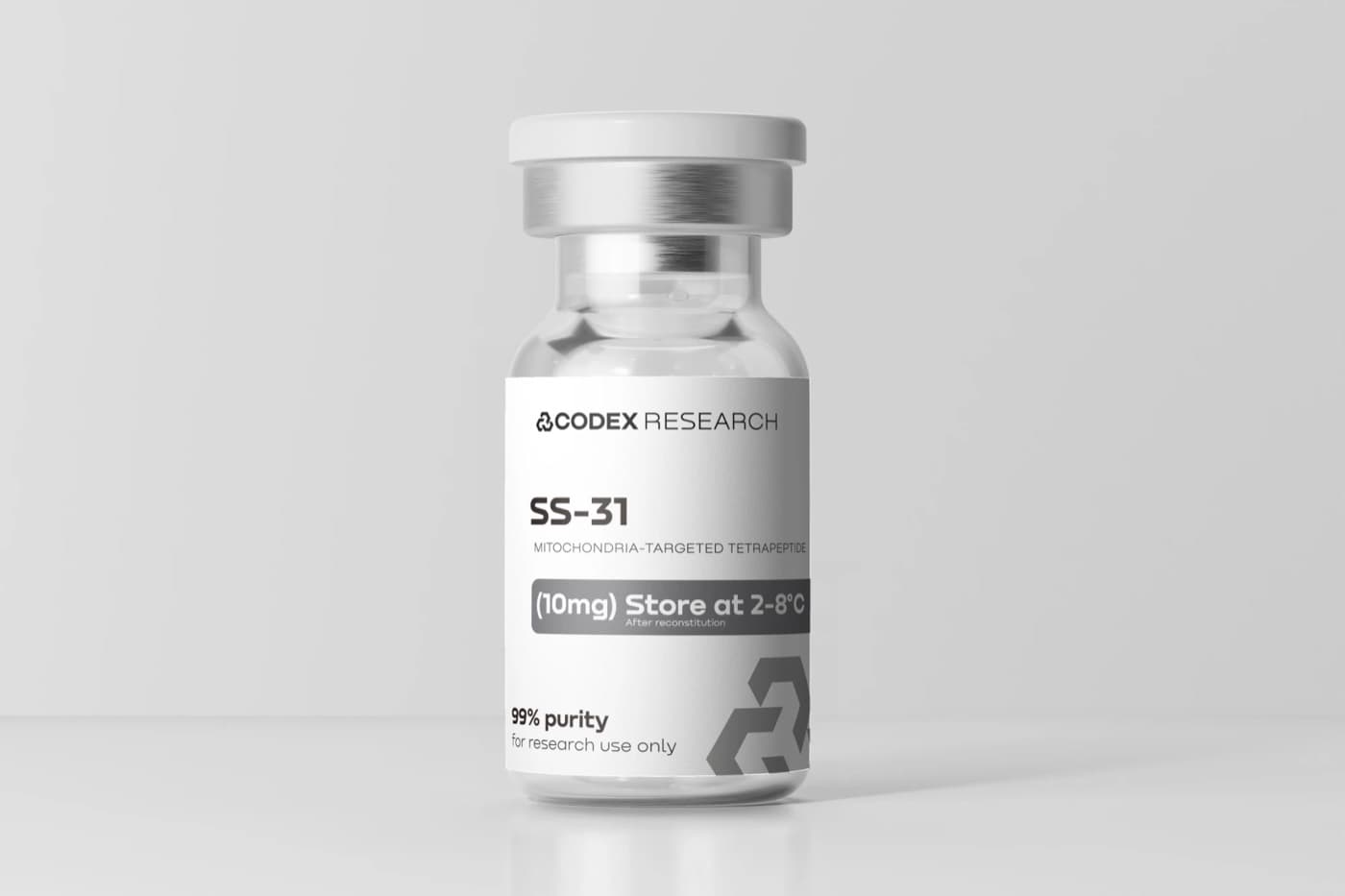
SS-31 is a four-amino-acid peptide that binds cardiolipin in the inner membrane of mitochondria. As elamipretide (Forzinity), it received FDA accelerated approval in September 2025 for Barth syndrome, while trials in other conditions have mostly missed their main goals.
Approved drug exists
Human trials
Also known as Elamipretide, Forzinity, MTP-131, Bendavia
SS-31 is a small synthetic peptide of four amino acids. It belongs to the Szeto-Schiller (SS) peptides, a family designed to cross cell membranes and collect in mitochondria. There it binds cardiolipin, a fat found almost only in the inner mitochondrial membrane that holds the energy-producing machinery in place (Szeto 2014; Birk 2013).
Stealth BioTherapeutics developed it under the names MTP-131, Bendavia and finally elamipretide. It was tested in heart attack, heart failure, primary mitochondrial myopathy, dry age-related macular degeneration and Barth syndrome, a rare inherited disease in which cardiolipin is abnormal. Most trials missed their main goals. On 19 September 2025 the FDA granted it accelerated approval as Forzinity for Barth syndrome, based on improved knee muscle strength, an intermediate measure; continued approval may depend on a confirmatory trial.
This makes SS-31 different from most peptides on this site: there is an approved, regulated drug with its own prescribing information. Products sold online as "SS-31" for research are not that drug and are not covered by the approval.
Strongest evidence: small randomised and open-label trials in Barth syndrome; several larger trials in other conditions were negative.
Legal status: FDA accelerated approval (Forzinity) for Barth syndrome only.
02
SS-31 dosing in the FDA label
The approved drug has an official dosing schedule in its FDA label. It is shown here as published, with its source.
Dosing from the current FDA-approved label of each drug.
Drug
Approved use
Dosing in the label
Forzinity (elamipretide)
Barth syndrome in patients weighing at least 30 kg (accelerated approval)
40 mg under the skin once daily, at the same time each day. 20 mg once daily in adults with severe kidney impairment (eGFR under 30 mL/min) who are not on dialysis.
Schedules reported for this peptide, with the syringe measure for each step and the supplies each one takes. Reported use is not evidence that a schedule works or is safe, and none of this is medical advice.
Standard, once daily
Subcutaneous injection, once a day
Community-reported
Reported in the research community. It has not been tested as a schedule in human trials. Worked out with a 10 mg vial + 1 mL bacteriostatic water (10 mg/mL, 100 mcg per unit).
Amounts as reported, with the syringe or spray measure for the vial below. Not a recommendation.
Period
Amount each time
U-100 units
Volume
Weeks 1-2
5 mg
50
0.5 mL
Week 3 on
10 mg
100
1 mL
Minimum supplies, worked out from the amounts above. Add a margin for losses.
Item
8 weeks
12 weeks
Injections
56
84
Total peptide
490 mg
770 mg
SS-31 vials (10 mg)
49
77
Bacteriostatic water
49 mL
77 mL
Water bottles (10 mL)
5
8
U-100 insulin syringes
56
84
Alcohol swabs (boxes of 100)
112 (2)
168 (2)
Higher, once daily
Subcutaneous injection, once a day
Community-reported
Reported in the research community. It has not been tested as a schedule in human trials. Worked out with a 10 mg vial + 1 mL bacteriostatic water (10 mg/mL, 100 mcg per unit).
Amounts as reported, with the syringe or spray measure for the vial below. Not a recommendation.
Period
Amount each time
U-100 units
Volume
Weeks 1-2
5 mg
50
0.5 mL
Weeks 3-4
10 mg
100
1 mL
Weeks 5-8
15 mg
2 injections of 75 units
1.5 mL
Week 9 on
20 mg
2 injections of 100 units
2 mL
Minimum supplies, worked out from the amounts above. Add a margin for losses.
Item
8 weeks
12 weeks
Injections
56
84
Total peptide
630 mg
1,190 mg
SS-31 vials (10 mg)
63
119
Bacteriostatic water
63 mL
119 mL
Water bottles (10 mL)
7
12
U-100 insulin syringes
84
140
Alcohol swabs (boxes of 100)
168 (2)
280 (3)
04
SS-31 doses used in studies
The dose each published study gave its participants, copied from the paper. Not dosing instructions; animal doses do not convert directly to people.
At a glance: 12 studies report a dose (10 in people, 2 in animals).
Doses used in human studies
Reid Thompson W 2021: 40 mg per day (Subcutaneous, once daily; 12 weeks on each arm of a crossover (4-week washout), then an open-label extension)
3 mg/kg, single injection; the 8-day schedule is not detailed in the abstract; see the paper
1 hour (single dose) and 8 days
05
Evidence at a glance
What has been studied, by type of evidence. A result in animals or cells is a reason to study something in people, not proof that it works in people.
In humans
Summarised
Elamipretide has a real human trial record, mostly sponsored by its developer. Results by condition:
Barth syndrome: in a 12-person placebo-controlled crossover trial, neither main goal was met (Thompson 2021). In the open-label extension, walking distance and knee muscle strength improved and stayed better up to 168 weeks in 8 people (Thompson 2024), and treated patients did better than untreated patients from records (Hornby 2022). These uncontrolled results underpin the accelerated approval.
Primary mitochondrial myopathy: a short intravenous trial suggested longer walking distance at the highest dose (Karaa 2018), and a 4-week crossover showed better self-reported fatigue but missed its main goal (Karaa 2020). The 218-person phase 3 trial MMPOWER-3 found no difference from placebo (Karaa 2023).
Heart failure: a single infusion slightly reduced heart volumes at the highest dose (Daubert 2017), but four weeks of daily injections did not change heart volume or function (Butler 2020).
Heart attack: given during stenting, it did not reduce heart muscle damage (Gibson 2016).
Dry macular degeneration: a 48-week trial missed both main goals, with some favourable secondary imaging findings (Ehlers 2025).
In short: elamipretide is generally well tolerated in trials, with injection-site reactions as the main side effect. Benefit has been suggested only in Barth syndrome, from very small and largely uncontrolled data, and has not been shown in the other conditions tested.
In animals
Summarised
Kidney injury
In rats given SS-31 before the blood supply to the kidney was cut off, mitochondrial structure was preserved, energy recovered faster and kidney injury was smaller (Birk 2013).
Ageing muscle
In old mice, a single injection brought muscle energy production back toward young levels within an hour and made muscle more resistant to fatigue; eight days of treatment improved endurance (Siegel 2013). Young mice showed no effect. Similar ageing claims have not been tested in people.
In cells (in vitro)
Nothing yet
No summary in our library yet. We only publish one after checking it against the original papers.
Proposed mechanisms from cell and animal studies. A plausible mechanism is not evidence of an effect in people.
The FDA label describes elamipretide as a mitochondrial cardiolipin binder. The supporting studies show:
Cardiolipin binding: SS-31 binds cardiolipin with high affinity in the inner mitochondrial membrane (Birk 2013).
Protection from oxidation: by binding cardiolipin it stops cytochrome c from acting as a peroxidase that damages the membrane, while keeping its normal role in energy production (Szeto 2014).
Energy production: it preserved the folded inner membrane (cristae) and sped up ATP recovery in rat kidneys (Birk 2013) and restored energy output in old mouse muscle (Siegel 2013).
07
Reconstitution
How concentration changes with the amount of liquid added. A U-100 insulin syringe holds 1 mL in 100 units, so each unit is 0.01 mL. Step-by-step guide.
Step by step
Wash your hands and work on a clean, uncluttered surface. Let a refrigerated vial reach room temperature so the stopper is easier to pierce.
Wipe the rubber stopper of the peptide vial and of the bacteriostatic water with a fresh alcohol swab, and let them air-dry.
Draw the chosen volume of bacteriostatic water into a sterile syringe. With 2 mL, a 10 mg vial ends up at 5,000 mcg/mL, or 50 mcg per U-100 unit.
Insert the needle through the stopper and let the water run slowly down the inside wall of the vial, not straight onto the powder.
Swirl or roll the vial gently until the powder dissolves. Do not shake it: foaming can damage some peptides.
Check the solution against the light. It should be clear; cloudiness or particles mean something is wrong with the vial or the water.
Write the date and the volume of water on the label. Every unit calculation later depends on that volume.
Store the reconstituted SS-31 vial in the refrigerator, away from light.
Concentration by volume
A 10 mg vial: concentration after adding the liquid, and how much peptide each U-100 unit (0.01 mL) holds.
Arithmetic only. It assumes the vial holds exactly what the label says.
Concentration
5,000 mcg/mL
Per U-100 unit
50 mcg
Volume for your amount
—
08
Measuring with a U-100 syringe
What each mark on an insulin syringe holds once the vial is mixed. This is arithmetic, not a dose.
Reading a U-100 syringe: how much peptide each mark holds in a 10 mg vial mixed with 2 mL. Not a dose.
Syringe mark
Volume
Peptide in that volume
5 units
0.05 mL
250 mcg
10 units
0.1 mL
500 mcg
20 units
0.2 mL
1 mg
25 units
0.25 mL
1.25 mg
50 units
0.5 mL
2.5 mg
100 units
1 mL
5 mg
A U-100 insulin syringe holds 1 mL in 100 units, so each unit is 0.01 mL. The marks measure volume, not peptide.
Syringes come in 0.3 mL (30 units), 0.5 mL (50 units) and 1 mL (100 units) sizes. The smaller ones have finer marks and are easier to read for small volumes.
Read the volume at the top edge of the plunger's rubber seal, at eye level.
Tap out air bubbles before reading: a bubble takes up volume and makes the reading wrong.
Use a new sterile syringe and needle every time, and dispose of them in a sharps container.
09
Supplies
What reconstituting and measuring a vial takes.
The peptide vial, with its certificate of analysis (COA) for that batch. See how to read a COA.
Bacteriostatic water (water with 0.9% benzyl alcohol), which keeps a multi-use vial from growing bacteria. Sterile water has no preservative.
Sterile syringes to add the water, and U-100 insulin syringes to measure.
Alcohol swabs for the stoppers.
A sharps container for used needles.
A label or marker to write the date and the volume of water on the vial.
10
Side effects, safety and legal status
Because elamipretide has been through clinical trials, its side effects in people are better described than for most peptides. Injection-site reactions (redness, pain, itching, hardening, bruising) were the most common, affecting most people in trials (Karaa 2020; Thompson 2024). The FDA label also lists a temporary rise in eosinophils (a type of white blood cell), hypersensitivity, and a warning about the preservative benzyl alcohol in newborns.
Approved drug vs research product: the approved product is made to regulated standards for one disease. Products sold as "SS-31" online are not checked for identity, purity, dose or sterility, and the trial safety data do not apply to them.
Kidney function: the drug is cleared by the kidneys, and the label calls for a lower dose in severe kidney impairment.
Limited evidence of benefit: outside Barth syndrome, larger trials did not show a benefit.
Injection risks: any injected product that is not sterile can cause infection or abscesses.
FDA
Accelerated approval as Forzinity (elamipretide) for Barth syndrome in patients weighing at least 30 kg, pending a confirmatory trial. Research products are not the approved drug.
Status checked on
Oct 26, 2026
11
Storing SS-31
Before mixing
Freeze-dried (lyophilised) peptide is the most stable form. It is usually kept refrigerated, or frozen for long storage, sealed and away from light.
Heat, moisture and light speed up degradation. Keep the vial in its box and avoid leaving it in a car or by a window.
After mixing
Keep the reconstituted vial refrigerated and away from light. Do not freeze it again: freezing and thawing a solution can break the peptide down.
How long a mixed vial stays good depends on the peptide and the diluent, and for most research peptides there is no published stability data. Follow the supplier's guidance and discard any vial that turns cloudy.
Pierce the stopper as few times as possible, and always with a new sterile needle after wiping it with alcohol.
Write the volume of water on the label (for example "2 mL"). Without it, the unit calculations cannot be checked later.
12
Questions about SS-31
Is SS-31 FDA-approved?
Accelerated approval as Forzinity (elamipretide) for Barth syndrome in patients weighing at least 30 kg, pending a confirmatory trial. Research products are not the approved drug.
What is the approved dose of SS-31?
The FDA label of each approved drug sets its dosing; section 02 shows it with the source. It applies to the prescription drug used as prescribed, not to research products.
What doses of SS-31 have been studied?
Our library has 13 studies on SS-31. The doses each one used are in section 04, next to the study. They are not dosing instructions.
How much SS-31 is in each syringe unit?
It depends on how much liquid is added to the vial. For a 10 mg vial with 2 mL, each U-100 unit holds 50 mcg. The reconstitution table and calculator work it out for other volumes.
Is SS-31 the same as elamipretide?
Yes. SS-31 is the research name of the molecule; elamipretide is its drug name, and Forzinity is the approved brand. Earlier trial names were MTP-131 and Bendavia.
What is SS-31 approved for?
Only for Barth syndrome, a rare inherited disease, in patients weighing at least 30 kg. It is an accelerated approval based on improved knee muscle strength, so a confirmatory trial may be required for it to stay on the market.
Did SS-31 work in mitochondrial myopathy?
Early small trials gave mixed signals, but the 218-person phase 3 trial MMPOWER-3 found no difference from placebo in walking distance or fatigue after 24 weeks.
How much bacteriostatic water goes into a 10 mg SS-31 vial?
There is no single correct volume: it only changes the concentration. For a 10 mg vial, 1 mL gives 10,000 mcg/mL, 2 mL gives 5,000 mcg/mL, 3 mL gives 3,333 mcg/mL. More water makes small amounts easier to measure; less water keeps volumes small. Whatever volume is used, write it on the label.
What does one unit on an insulin syringe mean?
On a U-100 syringe, 100 units = 1 mL, so one unit is 0.01 mL. How much peptide that holds depends on the concentration of the vial, which depends on how much water was added.
Can doses from animal studies of SS-31 be converted to people?
No. Animal doses are reported per kilogram for a different species, and scaling them to people is not reliable. That is why Upzo shows each study dose next to its study, unconverted.
How should SS-31 be stored?
Unopened freeze-dried vials are usually kept refrigerated and away from light. Once mixed, keep the vial refrigerated and follow the supplier's guidance on how long it lasts.
13
References
A phase 2/3 randomized clinical trial followed by an open-label extension to evaluate the effectiveness of elamipretide in Barth syndrome, a genetic disorder of mitochondrial cardiolipin metabolism. Reid Thompson W, Hornby B, Manuel R, et al. Genetics in Medicine. 2021;23:471-478. doi:10.1038/s41436-020-01006-8
Long-term efficacy and safety of elamipretide in patients with Barth syndrome: 168-week open-label extension results of TAZPOWER. Thompson WR, Manuel R, Abbruscato A, et al. Genetics in Medicine. 2024;26:101138. doi:10.1016/j.gim.2024.101138
Natural history comparison study to assess the efficacy of elamipretide in patients with Barth syndrome. Hornby B, Thompson WR, Almuqbil M, et al. Orphanet Journal of Rare Diseases. 2022;17:336. doi:10.1186/s13023-022-02469-5
Randomized dose-escalation trial of elamipretide in adults with primary mitochondrial myopathy. Karaa A, Haas R, Goldstein A, et al. Neurology. 2018;90:e1212-e1221. doi:10.1212/WNL.0000000000005255
A randomized crossover trial of elamipretide in adults with primary mitochondrial myopathy. Karaa A, Haas R, Goldstein A, et al. Journal of Cachexia, Sarcopenia and Muscle. 2020;11:909-918. doi:10.1002/jcsm.12559
Efficacy and Safety of Elamipretide in Individuals With Primary Mitochondrial Myopathy: The MMPOWER-3 Randomized Clinical Trial. Karaa A, Bertini E, Carelli V, et al. Neurology. 2023;101:e238-e252. doi:10.1212/WNL.0000000000207402
Novel Mitochondria-Targeting Peptide in Heart Failure Treatment: A Randomized, Placebo-Controlled Trial of Elamipretide. Daubert MA, Yow E, Dunn G, et al. Circulation: Heart Failure. 2017;10:e004389. doi:10.1161/CIRCHEARTFAILURE.117.004389
Effects of Elamipretide on Left Ventricular Function in Patients With Heart Failure With Reduced Ejection Fraction: The PROGRESS-HF Phase 2 Trial. Butler J, Khan MS, Anker SD, et al. Journal of Cardiac Failure. 2020;26:429-437. doi:10.1016/j.cardfail.2020.02.001
EMBRACE STEMI study: a Phase 2a trial to evaluate the safety, tolerability, and efficacy of intravenous MTP-131 on reperfusion injury in patients undergoing primary percutaneous coronary intervention. Gibson CM, Giugliano RP, Kloner RA, et al. European Heart Journal. 2016;37:1296-1303. doi:10.1093/eurheartj/ehv597
ReCLAIM-2: A Randomized Phase II Clinical Trial Evaluating Elamipretide in Age-related Macular Degeneration, Geographic Atrophy Growth, Visual Function, and Ellipsoid Zone Preservation. Ehlers JP, Hu A, Boyer D, et al. Ophthalmology Science. 2025;5:100628. doi:10.1016/j.xops.2024.100628
The mitochondrial-targeted compound SS-31 re-energizes ischemic mitochondria by interacting with cardiolipin. Birk AV, Liu S, Soong Y, et al. Journal of the American Society of Nephrology. 2013;24:1250-1261. doi:10.1681/ASN.2012121216
Mitochondrial-targeted peptide rapidly improves mitochondrial energetics and skeletal muscle performance in aged mice. Siegel MP, Kruse SE, Percival JM, et al. Aging Cell. 2013;12:763-771. doi:10.1111/acel.12102
First-in-class cardiolipin-protective compound as a therapeutic agent to restore mitochondrial bioenergetics. Szeto HH. British Journal of Pharmacology. 2014;171:2029-2050. doi:10.1111/bph.12461
Research supplier
For laboratory research use only.
Codex Research LabShips from Panama City · US domestic shipping
Research and education only. Not medical advice. Many peptides on this site are not approved by the FDA for human use. Doses shown are the ones used in published studies and are not a recommendation. Talk to a licensed clinician before using any of them. Read the full disclaimer.