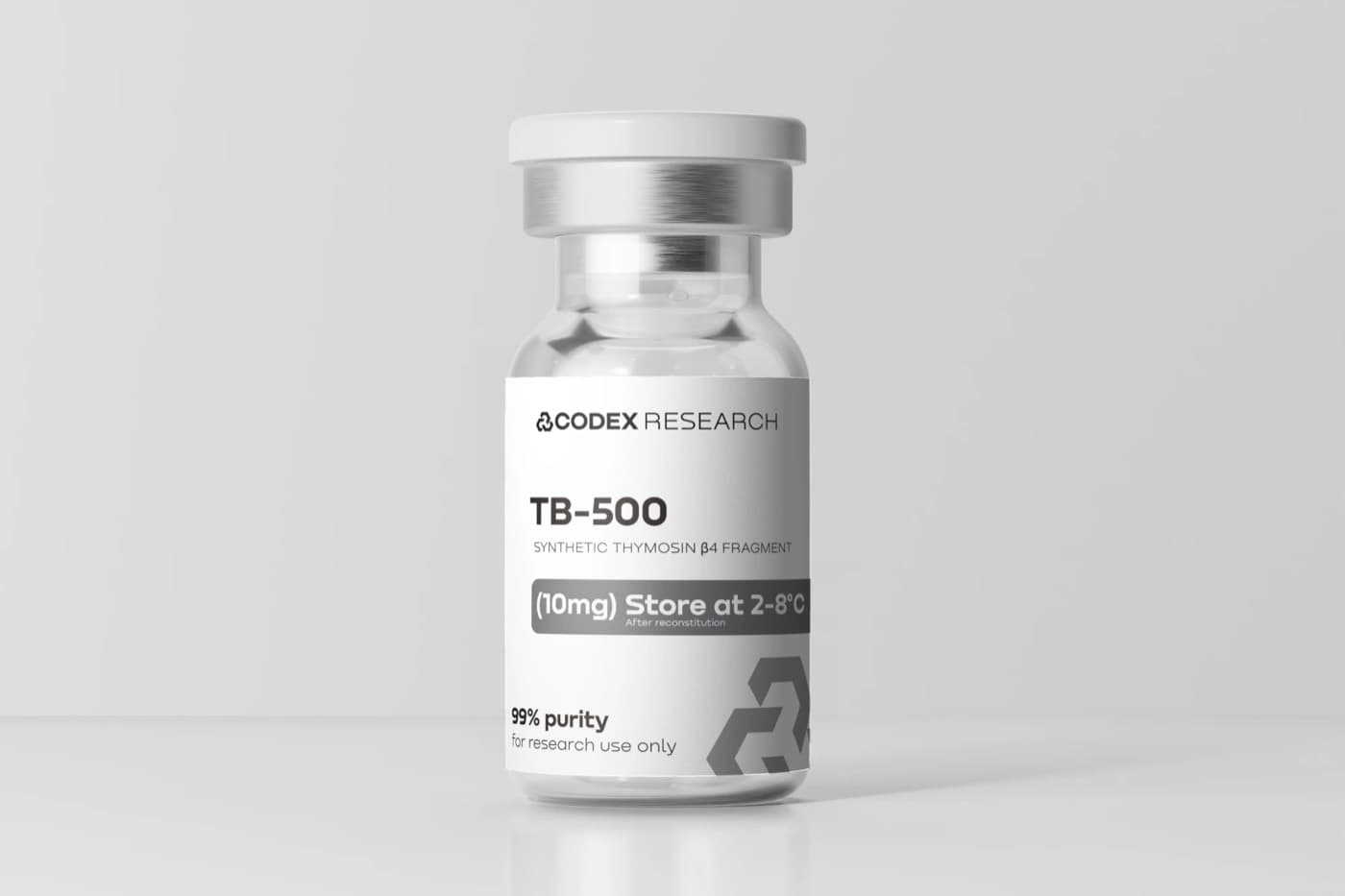
TB-500 is a synthetic seven-amino-acid peptide copied from the actin-binding region of thymosin beta-4, a natural protein involved in cell movement and repair. Almost all of the research cited for it was done on the full thymosin beta-4 protein, not on TB-500, and it is not FDA-approved.
Not FDA-approved
WADA prohibited
Human trials
Also known as Thymosin beta-4 fragment, Ac-LKKTETQ, Acetylated thymosin beta-4 (17-23)
Thymosin beta-4 (Tβ4) is a natural protein of 43 amino acids found in most human cells. It was named after the thymus because it was first sequenced from bovine thymus tissue in 1981 by Allan Goldstein's group. Its best-known job is binding actin, the protein that lets cells change shape and move. TB-500 is not the whole protein: anti-doping chemists who analysed a product sold as TB-500 found a seven-amino-acid piece of it, LKKTETQ (positions 17 to 23), with an acetyl group added to one end (Esposito 2012). TB-500 first appeared as a veterinary preparation, and horse-racing laboratories developed tests to detect it (Ho 2012).
This matters because most of what is said about TB-500 online comes from studies of the full Tβ4 protein. Full Tβ4 has been through early human trials as eye drops, a skin gel and an intravenous product (Ruff 2010; Sosne 2015). None of these products has been approved. The TB-500 fragment itself has never been tested in a published human study that we could find.
Work on the fragment is limited to one mouse wound study that compared it with full Tβ4 (Philp 2003), one rat tendon study (Biçer 2026) and drug-testing studies on how the body breaks it down (Rahaman 2024). On this page, each finding says whether it comes from full Tβ4 or from the fragment.
Type: synthetic seven-amino-acid fragment (Ac-LKKTETQ) of the 43-amino-acid protein thymosin beta-4.
Studied for: wound, tendon and heart repair (mostly as full Tβ4); dry eye and skin ulcers (full Tβ4 only).
Strongest evidence: for TB-500 itself, a few animal and cell studies. Small human trials exist only for full Tβ4.
Legal status: not approved as a medicine in the US; prohibited in sport by WADA.
02
TB-500 protocols and supplies
Schedules reported for this peptide, with the syringe measure for each step and the supplies each one takes. Reported use is not evidence that a schedule works or is safe, and none of this is medical advice.
Gradual, once daily
Subcutaneous injection, once a day
Community-reported
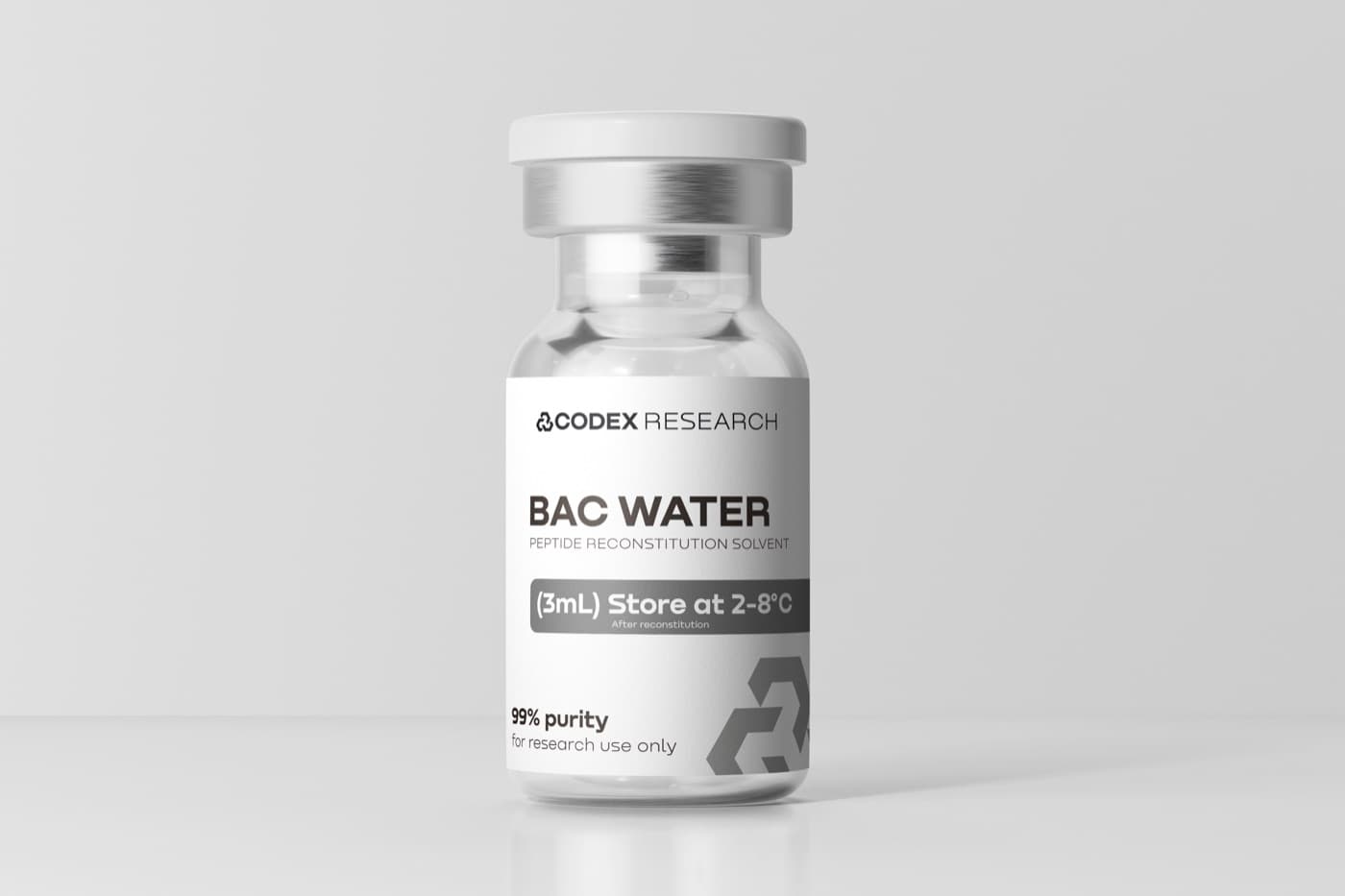
Reported in the research community. It has not been tested as a schedule in human trials. Worked out with a 10 mg vial + 3 mL bacteriostatic water (3.33 mg/mL, 33.3 mcg per unit).
Amounts as reported, with the syringe or spray measure for the vial below. Not a recommendation.
Period
Amount each time
U-100 units
Volume
Weeks 1-2
500 mcg
15
0.15 mL
Weeks 3-4
600 mcg
18
0.18 mL
Weeks 5-8
750 mcg
22.5
0.22 mL
Week 9 on
1 mg
30
0.3 mL
Minimum supplies, worked out from the amounts above. Add a margin for losses.
Item
8 weeks
12 weeks
16 weeks
Injections
56
84
112
Total peptide
36.4 mg
64.4 mg
92.4 mg
TB-500 vials (10 mg)
4
7
10
Bacteriostatic water
12 mL
21 mL
30 mL
Water bottles (10 mL)
2
3
3
U-100 insulin syringes
56
84
112
Alcohol swabs (boxes of 100)
112 (2)
168 (2)
224 (3)
03
TB-500 doses used in studies
The dose each published study gave its participants, copied from the paper. Not dosing instructions; animal doses do not convert directly to people.
At a glance: 12 studies report a dose (5 in people, 7 in animals).
Doses used in human studies
Ruff D 2010: Full synthetic thymosin beta-4 (not TB-500): 42, 140, 420 or 1260 mg, once and then daily (Intravenous; Single dose, then 14 days of daily doses)
Wang X 2021: Recombinant full thymosin beta-4 (NL005, not TB-500): single doses of 0.05 to 25.0 µg/kg; multiple doses of 0.5, 2.0 or 5.0 µg/kg daily (Intravenous; Single dose or 10 days, with 28 days of follow-up)
Guarnera G 2010: Full thymosin beta-4 (not TB-500) in escalating concentrations; the abstract names 0.03% as the most promising. Other concentrations not given in the abstract; see the paper (Topical)
Sosne G 2015: RGN-259 (full thymosin beta-4, not TB-500) 0.1%, 6 times daily (Eye drops; 28 days, plus 28 days of follow-up)
Sosne G 2015: RGN-259 (full thymosin beta-4, not TB-500) 0.1%; frequency not given in the abstract (Eye drops; 28 days)
Every study
Doses as reported by each study. Not a recommendation.
Full thymosin beta-4 (not TB-500) in escalating concentrations; the abstract names 0.03% as the most promising. Other concentrations not given in the abstract; see the paper
What has been studied, by type of evidence. A result in animals or cells is a reason to study something in people, not proof that it works in people.
In humans
Summarised
We could not find any published human study of TB-500 (the fragment). The human data below are all on the full thymosin beta-4 protein, and they cannot be assumed to apply to TB-500:
Intravenous safety (full Tβ4): 40 healthy volunteers in four dose groups received synthetic Tβ4 or placebo, first as one dose and then daily for 14 days. Adverse events were infrequent and mild or moderate, with no serious events (Ruff 2010). A Chinese phase 1 trial of a recombinant version reported similar tolerability in healthy adults (Wang 2021).
Dry eye (full Tβ4 eye drops, RGN-259): in a nine-patient randomised trial, the Tβ4 group had less discomfort and corneal staining than the vehicle group (Sosne 2015). In a larger 72-person trial, both main endpoints were missed, although some secondary measures improved (Sosne and Ousler 2015).
Venous leg ulcers (full Tβ4 gel): a phase 2 trial in 73 patients found the gel was tolerated about as well as placebo; the authors suggested one concentration might speed healing, but the abstract gives no clear comparison with placebo (Guarnera 2010).
Verdict: for TB-500 itself there is no human evidence of benefit or safety. For full Tβ4, small early trials suggest it was tolerated in the short term, with mixed signals of benefit in the eye and skin. A short fragment is a different molecule, and results from the whole protein should not be transferred to it.
In animals
Summarised
Skin wounds (full Tβ4 and the fragment)
Full Tβ4, applied to the skin or injected, was followed by faster wound closure, more collagen and more new blood vessels in rats (Malinda 1999). In a later study from the same NIH group, full Tβ4 helped wound repair in diabetic and very old mice, and the seven-amino-acid fragment LKKTETQ gave comparable results in the old mice (Philp 2003). That is the main published evidence that the fragment itself may share some of the parent protein's effects, and it comes from one lab.
Tendon (TB-500)
In 32 rats with a cut and repaired Achilles tendon, TB-500 injections for four weeks were followed by a stronger tendon on mechanical testing and better tissue scores than in untreated rats. Combining it with BPC-157 added nothing (Biçer 2026). The authors called the study exploratory, and it has not been repeated.
Heart (full Tβ4)
In mice with a blocked coronary artery, full Tβ4 was followed by better survival of heart muscle cells and better heart function (Bock-Marquette 2004). This work led to the intravenous human safety trials above. It has not been tested with the TB-500 fragment.
How the body handles TB-500
In rats, TB-500 was quickly broken into shorter pieces; the main one in urine was Ac-LK, and a piece called Ac-LKK could still be detected up to 72 hours later. In cell tests, only one breakdown piece (Ac-LKKTE), not TB-500 itself, sped up wound closure (Rahaman 2024). In horses, the fragment and its breakdown products could be detected in blood and urine after a single dose (Ho 2012).
In cells (in vitro)
Summarised
Full Tβ4 made skin cells (keratinocytes) migrate faster in a lab chamber (Malinda 1999) and helped heart muscle cells survive in culture (Bock-Marquette 2004). For the fragment, a Korean doping-control lab found that TB-500 did not harm fibroblasts in culture but did not speed up wound closure on its own (Rahaman 2024).
Proposed mechanisms from cell and animal studies. A plausible mechanism is not evidence of an effect in people.
How TB-500 might act is not established. The proposed pathways come mostly from full Tβ4, so they are marked by molecule:
Actin binding (fragment region): LKKTETQ is the part of Tβ4 described as its actin-binding site, the region the fragment copies (Ho 2012; Philp 2003).
Cell survival through ILK and Akt (full Tβ4): in heart cells, Tβ4 formed a complex with the enzyme ILK and switched on the survival signal Akt (Bock-Marquette 2004).
Cell migration and new blood vessels (full Tβ4): Tβ4 made keratinocytes migrate and was linked to more new vessels in rat wounds (Malinda 1999).
Activity of breakdown products (fragment): one study suggests that some wound-healing activity seen in cells may come from a breakdown piece, Ac-LKKTE, rather than TB-500 itself (Rahaman 2024).
06
Reconstitution
How concentration changes with the amount of liquid added. A U-100 insulin syringe holds 1 mL in 100 units, so each unit is 0.01 mL. Step-by-step guide.
Step by step
Wash your hands and work on a clean, uncluttered surface. Let a refrigerated vial reach room temperature so the stopper is easier to pierce.
Wipe the rubber stopper of the peptide vial and of the bacteriostatic water with a fresh alcohol swab, and let them air-dry.
Draw the chosen volume of bacteriostatic water into a sterile syringe. With 2 mL, a 10 mg vial ends up at 5,000 mcg/mL, or 50 mcg per U-100 unit.
Insert the needle through the stopper and let the water run slowly down the inside wall of the vial, not straight onto the powder.
Swirl or roll the vial gently until the powder dissolves. Do not shake it: foaming can damage some peptides.
Check the solution against the light. It should be clear; cloudiness or particles mean something is wrong with the vial or the water.
Write the date and the volume of water on the label. Every unit calculation later depends on that volume.
Store the reconstituted TB-500 vial in the refrigerator, away from light.
Concentration by volume
A 10 mg vial: concentration after adding the liquid, and how much peptide each U-100 unit (0.01 mL) holds.
Arithmetic only. It assumes the vial holds exactly what the label says.
Concentration
5,000 mcg/mL
Per U-100 unit
50 mcg
Volume for your amount
—
07
Measuring with a U-100 syringe
What each mark on an insulin syringe holds once the vial is mixed. This is arithmetic, not a dose.
Reading a U-100 syringe: how much peptide each mark holds in a 10 mg vial mixed with 2 mL. Not a dose.
Syringe mark
Volume
Peptide in that volume
5 units
0.05 mL
250 mcg
10 units
0.1 mL
500 mcg
20 units
0.2 mL
1 mg
25 units
0.25 mL
1.25 mg
50 units
0.5 mL
2.5 mg
100 units
1 mL
5 mg
A U-100 insulin syringe holds 1 mL in 100 units, so each unit is 0.01 mL. The marks measure volume, not peptide.
Syringes come in 0.3 mL (30 units), 0.5 mL (50 units) and 1 mL (100 units) sizes. The smaller ones have finer marks and are easier to read for small volumes.
Read the volume at the top edge of the plunger's rubber seal, at eye level.
Tap out air bubbles before reading: a bubble takes up volume and makes the reading wrong.
Use a new sterile syringe and needle every time, and dispose of them in a sharps container.
08
Supplies
What reconstituting and measuring a vial takes.
The peptide vial, with its certificate of analysis (COA) for that batch. See how to read a COA.
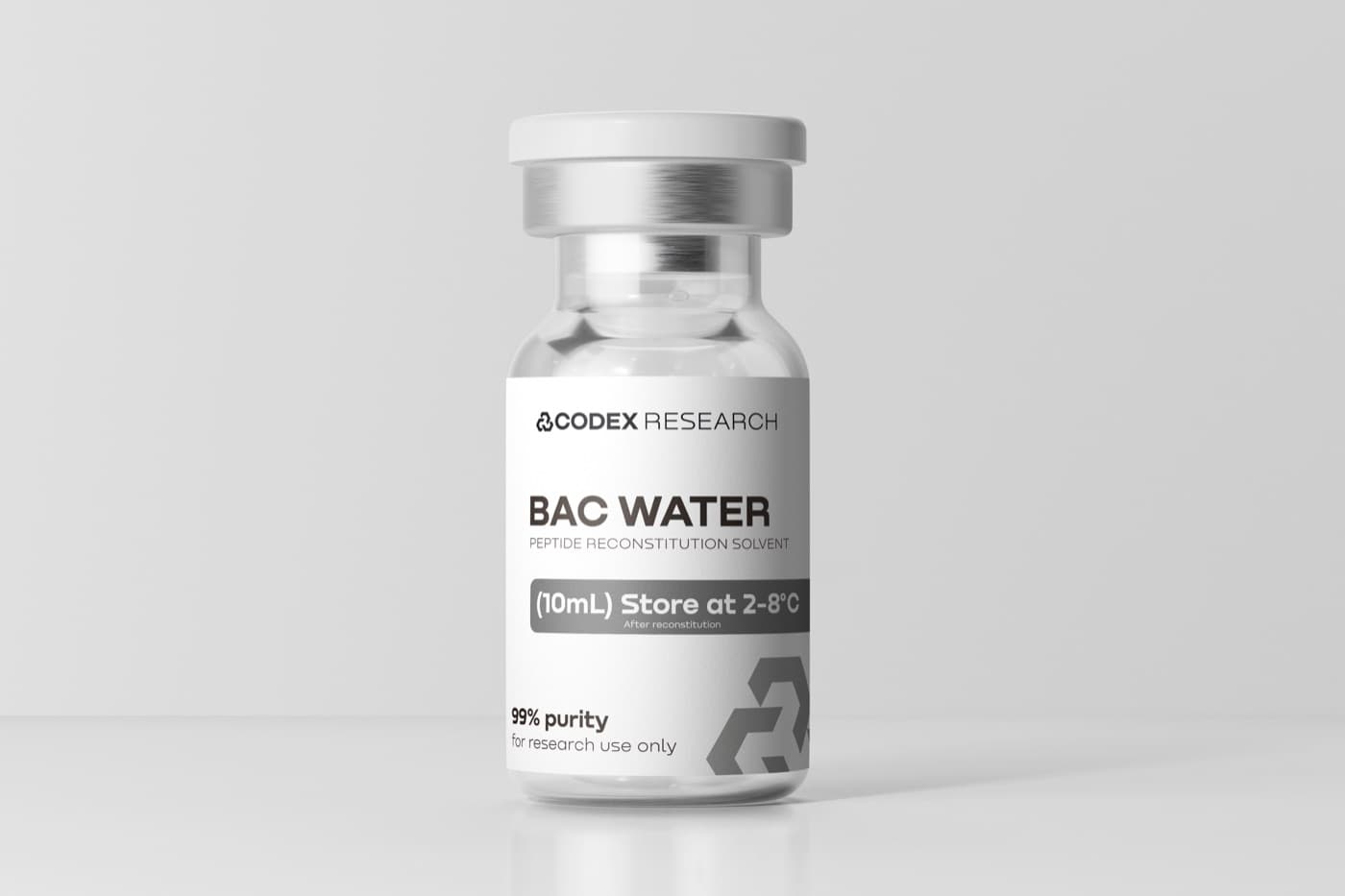
Bacteriostatic water (water with 0.9% benzyl alcohol), which keeps a multi-use vial from growing bacteria. Sterile water has no preservative.
Sterile syringes to add the water, and U-100 insulin syringes to measure.
Alcohol swabs for the stoppers.
A sharps container for used needles.
A label or marker to write the date and the volume of water on the vial.
09
Side effects, safety and legal status
There are no human safety data for TB-500. Short-term trials of the full Tβ4 protein reported mostly mild side effects (Ruff 2010; Wang 2021), but those used regulated, pharmaceutical-grade products, not the fragment sold online. A 2026 sports-medicine review groups TB-500 with other unapproved peptides for which rigorous human safety data are scarce (Mendias 2026).
Product quality: TB-500 sold online is not checked by any regulator for identity, purity, dose or sterility. What is in the vial may not match the label.
Fragment versus protein: results and safety data for full Tβ4 do not transfer automatically to a seven-amino-acid fragment.
Blood vessel growth: full Tβ4 has been linked to new blood vessel growth in animals. Tumours also rely on new vessels, so this is a theoretical concern for anyone with cancer or a history of it. It has not been studied for TB-500.
Injection risks: any injected product that is not sterile can cause infection or abscesses.
Sport: thymosin beta-4 and its derivatives, including TB-500, are prohibited at all times by WADA, and labs can detect the fragment and its breakdown products (Ho 2012; Esposito 2012).
FDA
Not FDA-approved for any use.
WADA
Prohibited at all times (thymosin beta-4 and its derivatives).
Status checked on
Oct 26, 2026
10
Storing TB-500
Before mixing
Freeze-dried (lyophilised) peptide is the most stable form. It is usually kept refrigerated, or frozen for long storage, sealed and away from light.
Heat, moisture and light speed up degradation. Keep the vial in its box and avoid leaving it in a car or by a window.
After mixing
Keep the reconstituted vial refrigerated and away from light. Do not freeze it again: freezing and thawing a solution can break the peptide down.
How long a mixed vial stays good depends on the peptide and the diluent, and for most research peptides there is no published stability data. Follow the supplier's guidance and discard any vial that turns cloudy.
Pierce the stopper as few times as possible, and always with a new sterile needle after wiping it with alcohol.
Write the volume of water on the label (for example "2 mL"). Without it, the unit calculations cannot be checked later.
11
Questions about TB-500
Is TB-500 FDA-approved?
Not FDA-approved for any use.
What doses of TB-500 have been studied?
Our library has 13 studies on TB-500. The doses each one used are in section 03, next to the study. They are not dosing instructions.
How much TB-500 is in each syringe unit?
It depends on how much liquid is added to the vial. For a 10 mg vial with 2 mL, each U-100 unit holds 50 mcg. The reconstitution table and calculator work it out for other volumes.
Is TB-500 the same as thymosin beta-4?
No. Thymosin beta-4 is a natural protein of 43 amino acids. A product sold as TB-500 was found to contain a synthetic seven-amino-acid piece of it (Ac-LKKTETQ). Most published research, including all the human trials, used the full protein.
Has TB-500 been tested in people?
We could not find any published human study of the TB-500 fragment. Small early-phase trials exist for full thymosin beta-4 as eye drops, a skin gel and an intravenous product, but none led to an approved medicine.
Can TB-500 be detected in drug tests?
Yes. Anti-doping labs have published methods that detect the fragment and its breakdown products in urine and blood, including methods developed for horse racing. Some breakdown products remained detectable for days in rats.
How much bacteriostatic water goes into a 10 mg TB-500 vial?
There is no single correct volume: it only changes the concentration. For a 10 mg vial, 1 mL gives 10,000 mcg/mL, 2 mL gives 5,000 mcg/mL, 3 mL gives 3,333 mcg/mL. More water makes small amounts easier to measure; less water keeps volumes small. Whatever volume is used, write it on the label.
What does one unit on an insulin syringe mean?
On a U-100 syringe, 100 units = 1 mL, so one unit is 0.01 mL. How much peptide that holds depends on the concentration of the vial, which depends on how much water was added.
Can doses from animal studies of TB-500 be converted to people?
No. Animal doses are reported per kilogram for a different species, and scaling them to people is not reliable. That is why Upzo shows each study dose next to its study, unconverted.
How should TB-500 be stored?
Unopened freeze-dried vials are usually kept refrigerated and away from light. Once mixed, keep the vial refrigerated and follow the supplier's guidance on how long it lasts.
12
References
Synthesis and characterization of the N-terminal acetylated 17-23 fragment of thymosin beta 4 identified in TB-500, a product suspected to possess doping potential. Esposito S, Deventer K, Goeman J, et al. Drug Testing and Analysis. 2012;4:733-738. doi:10.1002/dta.1402
Doping control analysis of TB-500, a synthetic version of an active region of thymosin β4, in equine urine and plasma by liquid chromatography-mass spectrometry. Ho EN, Kwok WH, Lau MY, et al. Journal of Chromatography A. 2012;1265:57-69. doi:10.1016/j.chroma.2012.09.043
Thymosin beta 4 and a synthetic peptide containing its actin-binding domain promote dermal wound repair in db/db diabetic mice and in aged mice. Philp D, Badamchian M, Scheremeta B, et al. Wound Repair and Regeneration. 2003;11:19-24. doi:10.1046/j.1524-475x.2003.11105.x
Simultaneous quantification of TB-500 and its metabolites in in-vitro experiments and rats by UHPLC-Q-Exactive orbitrap MS/MS and their screening by wound healing activities in-vitro. Rahaman KA, Muresan AR, Min H, et al. Journal of Chromatography B, Analytical Technologies in the Biomedical and Life Sciences. 2024;1235:124033. doi:10.1016/j.jchromb.2024.124033
Effects of BPC-157 and TB-500 on Achilles tendon healing in rats: A histopathological and biomechanical study. Biçer O, Adanir O, Güleryüz Y, et al. Joint Diseases and Related Surgery. 2026;37:822-837. doi:10.52312/jdrs.2026.2951
Safety and Efficacy of Approved and Unapproved Peptide Therapies for Musculoskeletal Injuries and Athletic Performance. Mendias CL, Awan TM. Sports Medicine. 2026;56:1921-1935. doi:10.1007/s40279-026-02437-0
A randomized, placebo-controlled, single and multiple dose study of intravenous thymosin beta4 in healthy volunteers. Ruff D, Crockford D, Girardi G, et al. Annals of the New York Academy of Sciences. 2010;1194:223-229. doi:10.1111/j.1749-6632.2010.05474.x
A first-in-human, randomized, double-blind, single- and multiple-dose, phase I study of recombinant human thymosin β4 in healthy Chinese volunteers. Wang X, Liu L, Qi L, et al. Journal of Cellular and Molecular Medicine. 2021;25:8222-8228. doi:10.1111/jcmm.16693
The effect of thymosin treatment of venous ulcers. Guarnera G, DeRosa A, Camerini R, et al. Annals of the New York Academy of Sciences. 2010;1194:207-212. doi:10.1111/j.1749-6632.2010.05490.x
Thymosin β4 significantly improves signs and symptoms of severe dry eye in a phase 2 randomized trial. Sosne G, Dunn SP, Kim C. Cornea. 2015;34:491-496. doi:10.1097/ICO.0000000000000379
Thymosin beta 4 ophthalmic solution for dry eye: a randomized, placebo-controlled, Phase II clinical trial conducted using the controlled adverse environment (CAE™) model. Sosne G, Ousler GW. Clinical Ophthalmology. 2015;9:877-884. doi:10.2147/OPTH.S80954
Thymosin beta4 activates integrin-linked kinase and promotes cardiac cell migration, survival and cardiac repair. Bock-Marquette I, Saxena A, White MD, et al. Nature. 2004;432:466-472. doi:10.1038/nature03000
Thymosin beta4 accelerates wound healing. Malinda KM, Sidhu GS, Mani H, et al. Journal of Investigative Dermatology. 1999;113:364-368. doi:10.1046/j.1523-1747.1999.00708.x
Research supplier
For laboratory research use only.
Codex Research LabShips from Panama City · US domestic shipping
Research and education only. Not medical advice. Many peptides on this site are not approved by the FDA for human use. Doses shown are the ones used in published studies and are not a recommendation. Talk to a licensed clinician before using any of them. Read the full disclaimer.