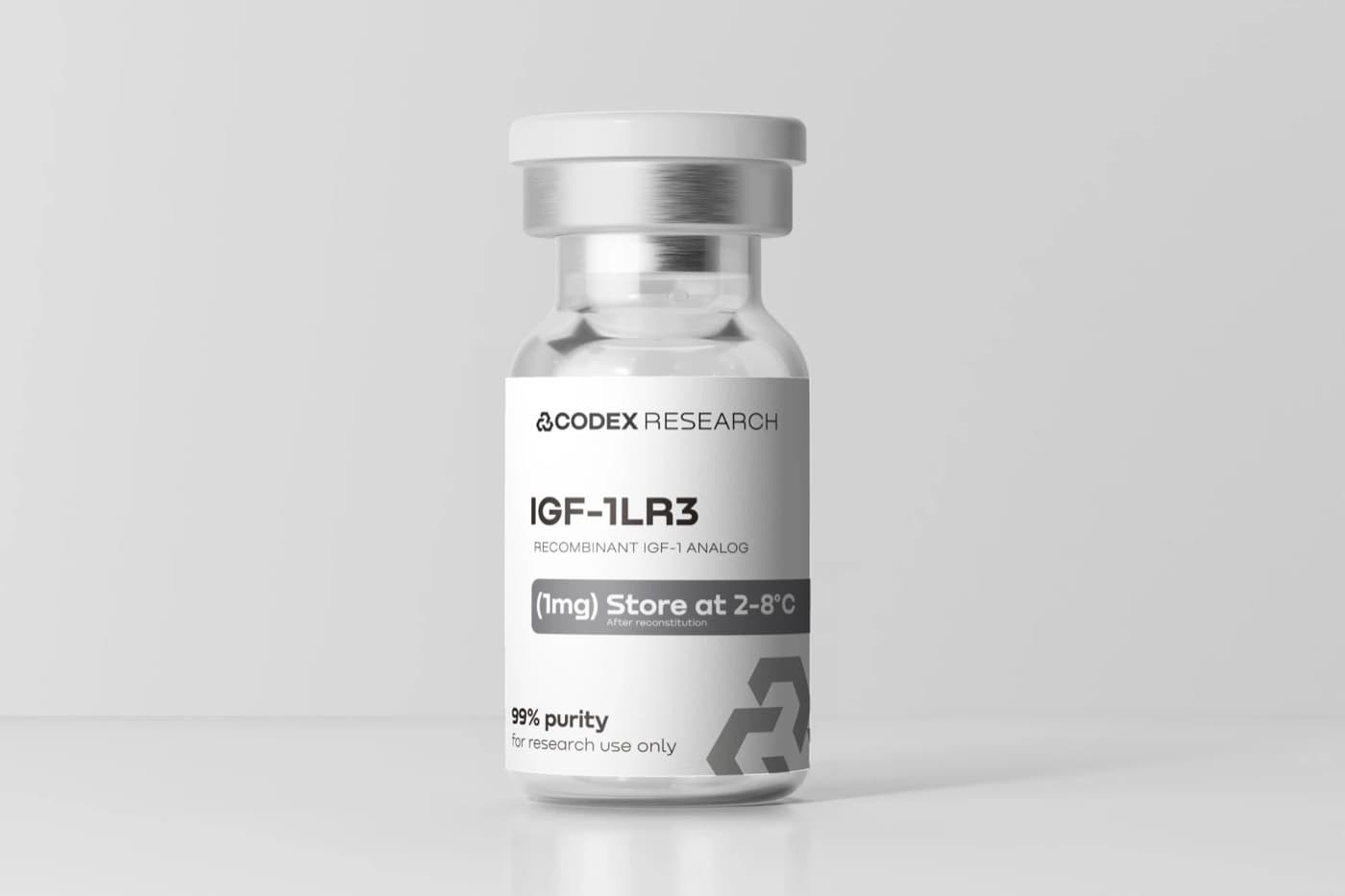
IGF-1 LR3 is a modified, longer-acting version of insulin-like growth factor 1, made for laboratory cell culture. It has never been tested in published human trials and is not FDA-approved.
Not FDA-approved
WADA prohibited
Limited human data
Also known as Long R3 IGF-1, LR3IGF-I, Long-R3-IGF-I, Insulin-like growth factor 1 LR3
IGF-1 (insulin-like growth factor 1) is a 70-amino-acid hormone made mainly in the liver in response to growth hormone. IGF-1 LR3 ("Long R3") changes it in two ways: the third amino acid, glutamic acid, is replaced by arginine (the "R3"), and a 13-amino-acid extension is added to the start (the "Long"), made of the first 11 amino acids of pig growth hormone plus two linking amino acids (Francis 1992).
It was made in the early 1990s by a research group in Adelaide, Australia. The changes make it bind poorly to the IGF-binding proteins that normally hold IGF-1 in check, so more of it stays free to act on cells. In cell lines that produce these binding proteins it was more potent than normal IGF-1, even though it binds the IGF-1 receptor itself less well (Francis 1992; Tomas 1992). Its main use since then has been as a growth supplement in laboratory cell culture.
IGF-1 LR3 should not be confused with mecasermin (Increlex), a recombinant copy of natural human IGF-1 that is FDA-approved for growth failure in children with severe primary IGF-1 deficiency. Mecasermin is a different molecule, and its clinical data do not apply to IGF-1 LR3.
Type: modified recombinant IGF-1, 83 amino acids (70 of IGF-1 plus a 13-amino-acid extension).
Studied for: growth and protein balance in rats, blood sugar effects in pigs, and use as a cell culture additive.
Strongest evidence: animal studies from the 1990s, mostly from the Adelaide group that developed it. No published human studies.
Legal status: not approved as a medicine anywhere in the US; prohibited in sport by WADA.
02
IGF-1 LR3 protocols and supplies
Schedules reported for this peptide, with the syringe measure for each step and the supplies each one takes. Reported use is not evidence that a schedule works or is safe, and none of this is medical advice.
Gradual, once daily
Subcutaneous injection, once a day
Community-reported
Reported in the research community. It has not been tested as a schedule in human trials. Worked out with a 1 mg vial + 3 mL bacteriostatic water (333 mcg/mL, 3.33 mcg per unit).
Amounts as reported, with the syringe or spray measure for the vial below. Not a recommendation.
Period
Amount each time
U-100 units
Volume
Weeks 1-2
20 mcg
6
0.06 mL
Weeks 3-4
40 mcg
12
0.12 mL
Week 5 on
50 mcg
15
0.15 mL
Minimum supplies, worked out from the amounts above. Add a margin for losses.
Item
8 weeks
12 weeks
16 weeks
Injections
56
84
112
Total peptide
2.24 mg
3.64 mg
5.04 mg
IGF-1 LR3 vials (1 mg)
3
4
6
Bacteriostatic water
9 mL
12 mL
18 mL
Water bottles (10 mL)
1
2
2
U-100 insulin syringes
56
84
112
Alcohol swabs (boxes of 100)
112 (2)
168 (2)
224 (3)
03
IGF-1 LR3 doses used in studies
The dose each published study gave its participants, copied from the paper. Not dosing instructions; animal doses do not convert directly to people.
At a glance: 7 studies report a dose (6 in animals, 1 in cells).
Doses as reported by each study. Not a recommendation.
Graded doses; the highest IGF-1 dose was 695 µg/day. LR3 doses not given in the abstract; see the paper. All rats also received dexamethasone 20 µg/day.
Pigs: 20 or 50 µg/kg of IGF-1 or a variant (including LR3), or insulin 3 µg/kg. Marmosets: 42-270 µg/kg of IGF-1 or des(1-3)IGF-I (LR3 was not tested in marmosets).
What has been studied, by type of evidence. A result in animals or cells is a reason to study something in people, not proof that it works in people.
In humans
Summarised
We could not find any published study in which IGF-1 LR3 was given to people. Its effects, safe exposure and side effects in humans are unknown. Human data on natural IGF-1 or on mecasermin cannot be transferred to it, because LR3 behaves differently in the body (it escapes the binding proteins that limit IGF-1).
In animals
Summarised
Growth and protein balance in rats
In rats given a steroid that breaks down muscle, IGF-1 LR3 was about 2.5 times more potent than IGF-1 at restoring weight gain and nitrogen balance, and it increased gut weight (Tomas 1992). In diabetic rats it restored growth, again 2.5 to 3 times more potently than IGF-1, but unlike insulin it did not reduce sugar in the urine (Tomas 1993). During food restriction it kept body weight higher but did not protect muscle protein, and in adult rats it increased muscle protein breakdown (Tomas 2001).
Blood sugar
In pigs, single injections of IGF-1 LR3 lowered blood sugar more strongly than IGF-1, and variants of this type kept it low for much longer: the total sugar-lowering effect over four hours was about 4 to 8 times greater (Tomas 1997). This is the clearest safety signal in the literature.
Brain
In a mouse model of Alzheimer's disease, 7 months of IGF-1 LR3 given into the nose changed the structure of amyloid plaques in the brain but did not preserve memory or behaviour (Engel 2025).
In cells (in vitro)
Summarised
In rat muscle cells and other cell lines that produce IGF-binding proteins, IGF-1 LR3 stimulated protein and DNA synthesis more potently than IGF-1. In chick cells that do not make binding proteins it was less potent than IGF-1, which shows its extra strength comes from escaping the binding proteins, not from stronger receptor binding (Francis 1992). This is why it is widely used in cell culture.
Proposed mechanisms from cell and animal studies. A plausible mechanism is not evidence of an effect in people.
IGF-1 LR3 acts on the same receptor as natural IGF-1. What differs is how much of it is free to act:
Escape from binding proteins: the arginine at position 3 and the N-terminal extension reduce binding to IGF-binding proteins, so more of the peptide reaches cells (Francis 1992).
Weaker receptor binding, stronger effect: it binds the IGF-1 receptor about 3 times less well than IGF-1 but was still about 2.5 times more potent in rats (Tomas 1992).
Insulin-like action: like IGF-1 it lowers blood sugar, and more strongly and for longer than IGF-1 in pigs (Tomas 1997).
06
Reconstitution
How concentration changes with the amount of liquid added. A U-100 insulin syringe holds 1 mL in 100 units, so each unit is 0.01 mL. Step-by-step guide.
Step by step
Wash your hands and work on a clean, uncluttered surface. Let a refrigerated vial reach room temperature so the stopper is easier to pierce.
Wipe the rubber stopper of the peptide vial and of the bacteriostatic water with a fresh alcohol swab, and let them air-dry.
Draw the chosen volume of bacteriostatic water into a sterile syringe. With 2 mL, a 1 mg vial ends up at 500 mcg/mL, or 5 mcg per U-100 unit.
Insert the needle through the stopper and let the water run slowly down the inside wall of the vial, not straight onto the powder.
Swirl or roll the vial gently until the powder dissolves. Do not shake it: foaming can damage some peptides.
Check the solution against the light. It should be clear; cloudiness or particles mean something is wrong with the vial or the water.
Write the date and the volume of water on the label. Every unit calculation later depends on that volume.
Store the reconstituted IGF-1 LR3 vial in the refrigerator, away from light.
Concentration by volume
A 1 mg vial: concentration after adding the liquid, and how much peptide each U-100 unit (0.01 mL) holds.
Arithmetic only. It assumes the vial holds exactly what the label says.
Concentration
500 mcg/mL
Per U-100 unit
5 mcg
Volume for your amount
—
07
Measuring with a U-100 syringe
What each mark on an insulin syringe holds once the vial is mixed. This is arithmetic, not a dose.
Reading a U-100 syringe: how much peptide each mark holds in a 1 mg vial mixed with 2 mL. Not a dose.
Syringe mark
Volume
Peptide in that volume
5 units
0.05 mL
25 mcg
10 units
0.1 mL
50 mcg
20 units
0.2 mL
100 mcg
25 units
0.25 mL
125 mcg
50 units
0.5 mL
250 mcg
100 units
1 mL
500 mcg
A U-100 insulin syringe holds 1 mL in 100 units, so each unit is 0.01 mL. The marks measure volume, not peptide.
Syringes come in 0.3 mL (30 units), 0.5 mL (50 units) and 1 mL (100 units) sizes. The smaller ones have finer marks and are easier to read for small volumes.
Read the volume at the top edge of the plunger's rubber seal, at eye level.
Tap out air bubbles before reading: a bubble takes up volume and makes the reading wrong.
Use a new sterile syringe and needle every time, and dispose of them in a sharps container.
08
Supplies
What reconstituting and measuring a vial takes.
The peptide vial, with its certificate of analysis (COA) for that batch. See how to read a COA.
Bacteriostatic water (water with 0.9% benzyl alcohol), which keeps a multi-use vial from growing bacteria. Sterile water has no preservative.
Sterile syringes to add the water, and U-100 insulin syringes to measure.
Alcohol swabs for the stoppers.
A sharps container for used needles.
A label or marker to write the date and the volume of water on the vial.
09
Side effects, safety and legal status
There are no human safety data. Everything known about its effects comes from rats, mice, pigs and cells.
Low blood sugar: in pigs it caused stronger and longer-lasting drops in blood sugar than IGF-1 (Tomas 1997). Severe low blood sugar is a listed risk even for the approved IGF-1 drug mecasermin.
Cell growth: IGF-1 is a growth signal for many cells, including some cancer cells. The long-term effects of a more potent, unregulated IGF-1 analogue are unknown.
Product quality: a doping control lab found a black market vial containing a laboratory form of Long R3 IGF-1 with a purification tag still attached, a version made for research use whose effects in people are unknown (Kohler 2010).
Injection risks: any injected product that is not sterile can cause infection or abscesses.
Sport: IGF-1 and its analogues are on the WADA prohibited list at all times.
FDA
Not FDA-approved for any use.
WADA
Prohibited at all times (IGF-1 and its analogues).
Status checked on
Oct 26, 2026
10
Storing IGF-1 LR3
Before mixing
Freeze-dried (lyophilised) peptide is the most stable form. It is usually kept refrigerated, or frozen for long storage, sealed and away from light.
Heat, moisture and light speed up degradation. Keep the vial in its box and avoid leaving it in a car or by a window.
After mixing
Keep the reconstituted vial refrigerated and away from light. Do not freeze it again: freezing and thawing a solution can break the peptide down.
How long a mixed vial stays good depends on the peptide and the diluent, and for most research peptides there is no published stability data. Follow the supplier's guidance and discard any vial that turns cloudy.
Pierce the stopper as few times as possible, and always with a new sterile needle after wiping it with alcohol.
Write the volume of water on the label (for example "2 mL"). Without it, the unit calculations cannot be checked later.
11
Questions about IGF-1 LR3
Is IGF-1 LR3 FDA-approved?
Not FDA-approved for any use.
What doses of IGF-1 LR3 have been studied?
Our library has 7 studies on IGF-1 LR3. The doses each one used are in section 03, next to the study. They are not dosing instructions.
How much IGF-1 LR3 is in each syringe unit?
It depends on how much liquid is added to the vial. For a 1 mg vial with 2 mL, each U-100 unit holds 5 mcg. The reconstitution table and calculator work it out for other volumes.
Is IGF-1 LR3 the same as the approved IGF-1 drug?
No. The approved drug, mecasermin (Increlex), is a copy of natural human IGF-1. IGF-1 LR3 is a modified molecule with an extra 13 amino acids and a substitution at position 3, and it has never been tested in published human trials.
Why is IGF-1 LR3 used in laboratories?
It binds poorly to the IGF-binding proteins that cells release, so it stays active longer in cell culture and supports cell growth at lower amounts than normal IGF-1.
Has IGF-1 LR3 been tested in humans?
We could not find any published human study. All the research is in cells and animals, mainly rats and pigs.
How much bacteriostatic water goes into a 1 mg IGF-1 LR3 vial?
There is no single correct volume: it only changes the concentration. For a 1 mg vial, 1 mL gives 1,000 mcg/mL, 2 mL gives 500 mcg/mL, 3 mL gives 333 mcg/mL. More water makes small amounts easier to measure; less water keeps volumes small. Whatever volume is used, write it on the label.
What does one unit on an insulin syringe mean?
On a U-100 syringe, 100 units = 1 mL, so one unit is 0.01 mL. How much peptide that holds depends on the concentration of the vial, which depends on how much water was added.
Can doses from animal studies of IGF-1 LR3 be converted to people?
No. Animal doses are reported per kilogram for a different species, and scaling them to people is not reliable. That is why Upzo shows each study dose next to its study, unconverted.
How should IGF-1 LR3 be stored?
Unopened freeze-dried vials are usually kept refrigerated and away from light. Once mixed, keep the vial refrigerated and follow the supplier's guidance on how long it lasts.
12
References
Novel recombinant fusion protein analogues of insulin-like growth factor (IGF)-I indicate the relative importance of IGF-binding protein and receptor binding for enhanced biological potency. Francis GL, Ross M, Ballard FJ, et al. Journal of Molecular Endocrinology. 1992;8:213-223. doi:10.1677/jme.0.0080213
Insulin-like growth factor-I (IGF-I) and especially IGF-I variants are anabolic in dexamethasone-treated rats. Tomas FM, Knowles SE, Owens PC, et al. Biochemical Journal. 1992;282:91-97. doi:10.1042/bj2820091
Insulin-like growth factor-I and more potent variants restore growth of diabetic rats without inducing all characteristic insulin effects. Tomas FM, Knowles SE, Owens PC, et al. Biochemical Journal. 1993;291:781-786. doi:10.1042/bj2910781
IGF-I variants which bind poorly to IGF-binding proteins show more potent and prolonged hypoglycaemic action than native IGF-I in pigs and marmoset monkeys. Tomas FM, Walton PE, Dunshea FR, et al. Journal of Endocrinology. 1997;155:377-386. doi:10.1677/joe.0.1550377
Insulin-like growth factor-I (IGF-I) analogue, LR(3)IGF-I, ameliorates the loss of body weight but not of skeletal muscle during food restriction. Tomas FM Growth Hormone & IGF Research. 2001;11:92-103. doi:10.1054/ghir.2000.0194
Detection of His-tagged Long-R³-IGF-I in a black market product. Kohler M, Thomas A, Walpurgis K, et al. Growth Hormone & IGF Research. 2010;20:386-390. doi:10.1016/j.ghir.2010.07.001
Intranasal long R3 insulin-like growth factor-1 treatment promotes amyloid plaque remodeling in cerebral cortex but fails to preserve cognitive function in male 5XFAD mice. Engel MG, Narayan S, Cui MH, et al. Journal of Alzheimer's Disease. 2025;103:113-126. doi:10.1177/13872877241299056
Research supplier
For laboratory research use only.
Codex Research LabShips from Panama City · US domestic shipping
Research and education only. Not medical advice. Many peptides on this site are not approved by the FDA for human use. Doses shown are the ones used in published studies and are not a recommendation. Talk to a licensed clinician before using any of them. Read the full disclaimer.