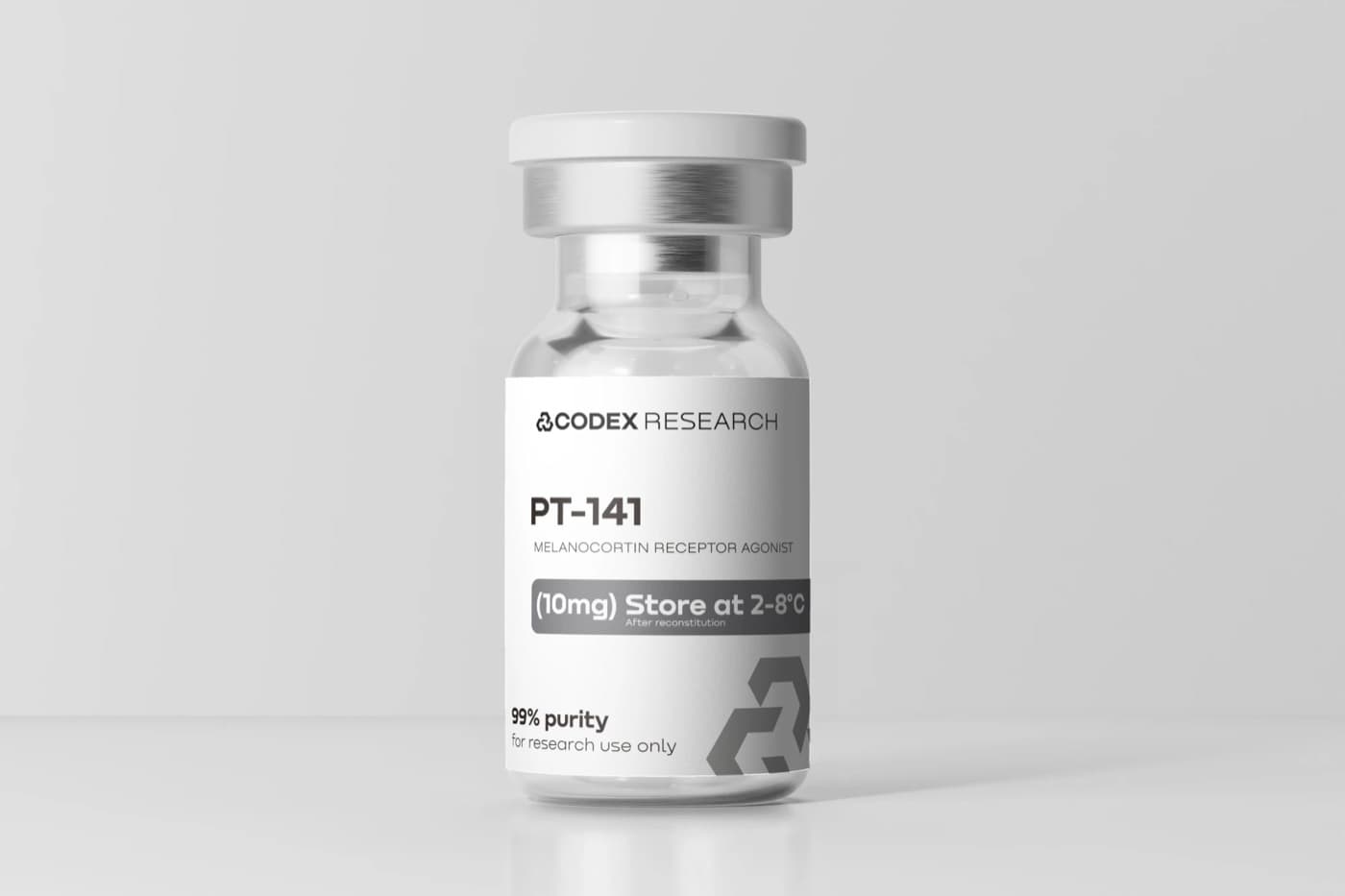
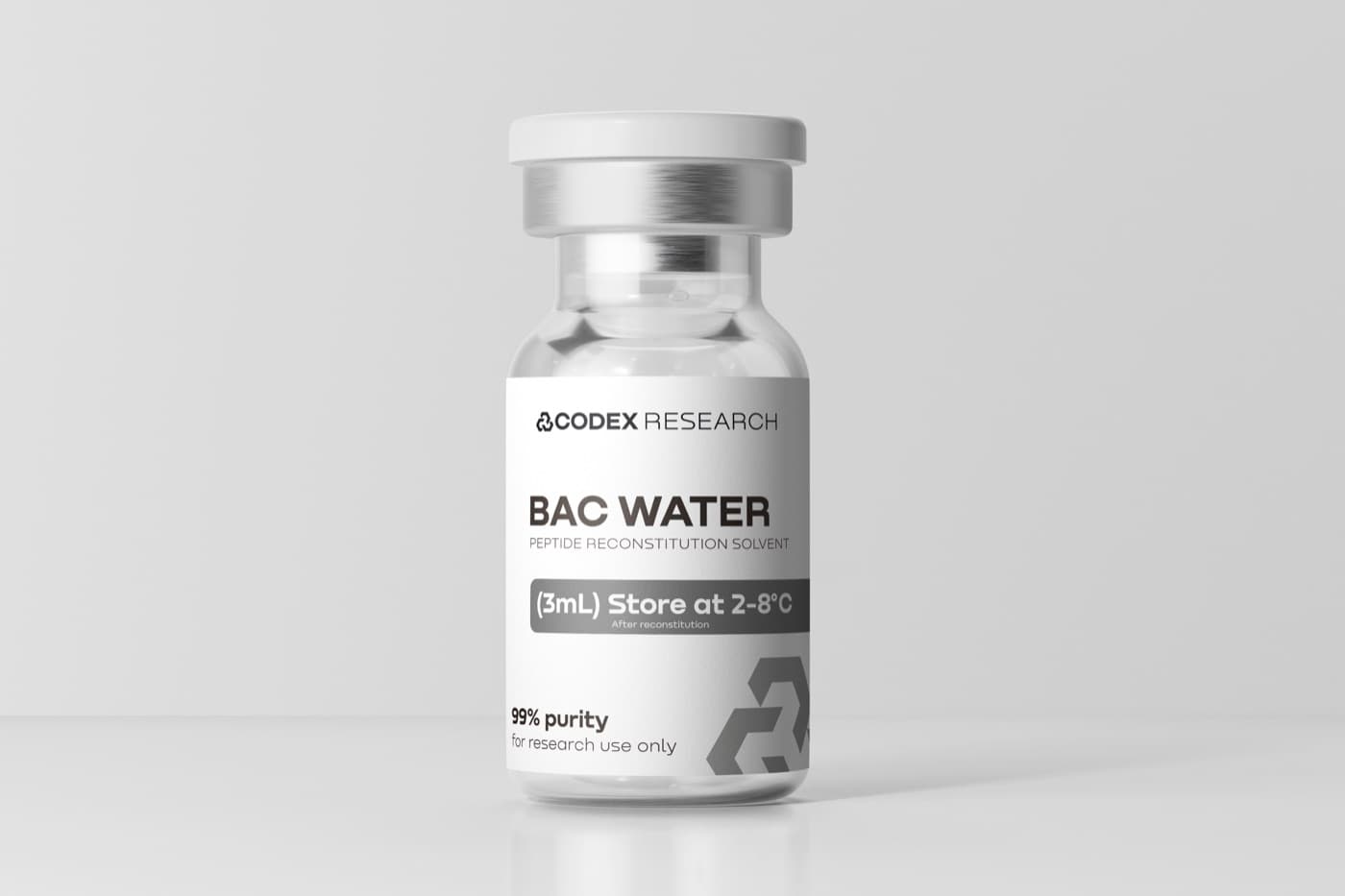
Melanocortin agonist

PT-141 (10 mg vial) dosage protocol

Dosage chart, U-100 syringe units and supplies for a 10 mg vial of PT-141 mixed with 3 mL. For the full research summary, see the PT-141 page.

01

PT-141 quick reference (10 mg vial)

Vial contents
10 mg PT-141
Final volume
3 mL
Concentration
3.33 mg/mL
One U-100 unit
33.3 mcg in 0.01 mL
02

PT-141 dosage chart

Amounts as reported for this peptide, with the syringe measure for this vial. Reported use is not evidence that a schedule works or is safe, and none of this is medical advice.

Gradual, once daily

  • Subcutaneous injection, once a day
  • Community-reported

Reported in the research community. It has not been tested as a schedule in human trials. Worked out with a 10 mg vial + 3 mL bacteriostatic water (3.33 mg/mL, 33.3 mcg per unit).

Amounts as reported, with the syringe or spray measure for the vial below. Not a recommendation.
PeriodAmount each timeU-100 unitsVolume
Weeks 1-8500 mcg150.15 mL
Weeks 9-121 mg300.3 mL
Week 13 on1.5 mg450.45 mL

Reconstitution steps

  1. Draw 3 mL of bacteriostatic water with a sterile syringe.
  2. Inject it slowly down the inside wall of the vial, not onto the powder, to avoid foaming.
  3. Swirl or roll the vial gently until the powder dissolves. Do not shake it.
  4. Label it with the date and the volume of water, and refrigerate at 2-8 °C (36-46 °F), away from light.
03

Supplies needed

Minimum supplies for each length of the schedule above, with 10 mg vials and 3 mL of water per vial. One new syringe per injection (two if over 1 mL), two alcohol swabs per injection, 10 mL water bottles.

Gradual, once daily

  • Subcutaneous injection, once a day
  • Community-reported
Minimum supplies, worked out from the amounts above. Add a margin for losses.
Item8 weeks12 weeks16 weeks
Injections5684112
Total peptide28 mg56 mg98 mg
PT-141 vials (10 mg)3610
Bacteriostatic water9 mL18 mL30 mL
Water bottles (10 mL)123
U-100 insulin syringes5684112
Alcohol swabs (boxes of 100)112 (2)168 (2)224 (3)

Research supplier

For laboratory research use only.

Codex Research LabShips from Panama City · US domestic shipping

04

Peptide reconstitution

Try other volumes of water: the concentration and the units per amount change with it.

Reconstitution calculator

Arithmetic only. It assumes the vial holds exactly what the label says.

Concentration
3,333 mcg/mL
Per U-100 unit
33.33 mcg
Volume for your amount
—
Concentration of a 10 mg vial after adding the liquid, and peptide per U-100 unit (0.01 mL).
Liquid addedConcentrationPer unit
1 mL10,000 mcg/mL100 mcg
2 mL5,000 mcg/mL50 mcg
3 mL3,333 mcg/mL33.3 mcg
05

PT-141 vial and research context

  • Reconstitute: add 3 mL of bacteriostatic water for a 3.33 mg/mL solution.
  • Amounts in the chart: 500 mcg-1.5 mg each time, by subcutaneous injection, once a day.
  • Easy measuring: at 3.33 mg/mL, one unit (0.01 mL) on a U-100 insulin syringe holds about 33.3 mcg.
  • Storage: freeze-dried, keep it sealed, cold and away from light (frozen for long storage). Once mixed, refrigerate at 2-8 °C and avoid freezing and thawing.

PT-141 is the research name for bremelanotide, a synthetic peptide that activates melanocortin receptors in the brain. As Vyleesi, it is FDA-approved for one form of low sexual desire in premenopausal women; products sold as "PT-141" are not that approved drug.

06

PT-141 10 mg protocol overview

  • Primary calculation: 10 mg made up to 3 mL equals 3.33 mg/mL.
  • Amounts shown: 500 mcg-1.5 mg per administration. Reported in the research community. It has not been tested as a schedule in human trials.
  • Route and frequency: subcutaneous injection, once a day.
  • Evidence ceiling: 7 of the 8 studies with a dose in our library were done in people.
  • Regulatory status: FDA-approved as Vyleesi (bremelanotide) for one indication. Products sold as "PT-141" for research are not the approved drug.
  • Approved drug: the prescription drug has its own dosing in its FDA label. See the label dosing.
07

How to read the PT-141 dosage chart

A 10 mg vial holds 10,000 mcg of PT-141. Adding 3 mL gives 3.33 mg/mL, so one U-100 unit (0.01 mL) holds 33.3 mcg. To get the units for an amount, divide it by 33.3 mcg. The units are a volume mark on the syringe, not a measure of potency.

  • 500 mcg: 0.15 mL, or 15 U-100 units.
  • 1 mg: 0.3 mL, or 30 U-100 units.
  • 1.5 mg: 0.45 mL, or 45 U-100 units.

Vial coverage by mass: 20 full amounts of 500 mcg, 10 full amounts of 1 mg, 6 full amounts of 1.5 mg per vial, before any handling loss.

If a different volume of water is used, every unit figure changes: recalculate with the calculator above.

08

Human PT-141 dosage evidence

Bremelanotide has more human data than most peptides on this site, because it went through a full drug development programme. The main studies:

  • Early studies in men: as a nasal spray in healthy men and men with erectile dysfunction, doses above 7 mg produced erections measured by a device, starting about 30 minutes after dosing; flushing and nausea were the most common side effects (Diamond 2004). An injected form produced erections in men who had not responded well to sildenafil (Rosen 2004). It was never approved for men.
  • First study in women: in 18 premenopausal women with sexual arousal disorder, a single 20 mg nasal dose increased the number who reported moderate or high desire compared with placebo, but did not change measured genital blood flow (Diamond 2006).
  • Phase 2b dose-finding trial: 327 women used 0.75, 1.25 or 1.75 mg injections or placebo as desired for 12 weeks. The two higher doses together increased satisfying sexual events by 0.7 per month versus 0.2 with placebo, and improved desire and distress scores (Clayton 2016).
  • Phase 3 trials (RECONNECT): two 24-week trials in 1,267 premenopausal women with HSDD found that 1.75 mg as needed improved desire and reduced distress compared with placebo. These are the basis of the FDA approval (Kingsberg 2019).
  • Long-term extension: 684 women continued in a 52-week open-label phase; 272 completed it. No new safety signals were reported, and improvements in desire scores were maintained in those who stayed (Simon 2019).
  • Blood pressure study: ambulatory monitoring in 397 women showed small, short-lived rises in blood pressure and falls in heart rate after dosing (White 2017).
  • Pooled safety review: across 43 studies and about 3,500 people, nausea, flushing and headache were the most common side effects (Clayton 2022).

Verdict: in premenopausal women with HSDD, bremelanotide produced a statistically clear but modest improvement in desire and distress scores compared with placebo, at the cost of frequent nausea. Most of the evidence comes from the developers, and an independent re-analysis questioned how meaningful the benefit is (Spielmans 2021). There is no comparable evidence for men, for postmenopausal women, or for any other use.

Doses used in human studies

  • Kingsberg SA 2019: 1.75 mg as needed before anticipated sexual activity (Subcutaneous autoinjector, as needed; 24 weeks)
  • Diamond LE 2004: Range of single intranasal doses; erectile responses were significant at doses above 7 mg. Full dose range not given in the abstract; see the paper (Intranasal, single doses)
  • Rosen RC 2004: 0.3 to 10 mg in healthy men; placebo, 4 mg or 6 mg in a crossover design in men with erectile dysfunction (Subcutaneous, single doses)
  • Diamond LE 2006: 20 mg single intranasal dose, or placebo, in a double-blind crossover design (Intranasal, single dose; Two in-clinic sessions, with responses recorded over the following 24 hours)
  • Clayton AH 2016: 0.75 mg, 1.25 mg or 1.75 mg, or placebo, self-administered as desired (Subcutaneous, self-administered as desired; 12 weeks)
  • White WB 2017: 0.75 mg, 1.25 mg or 1.75 mg, or placebo (Subcutaneous)

Every study dose, including animal and cell studies, is in the PT-141 dose table.

09

PT-141 safety, side effects and evidence limits

Because it is an approved drug, bremelanotide's side effects are better documented than those of most peptides. In the double-blind phase 3 trials, side effects were common and were the main reason people stopped (Clayton 2022). The FDA prescribing information lists uncontrolled high blood pressure and known cardiovascular disease as reasons not to use it.

  • Nausea, flushing and headache: nausea affected 40.0% on bremelanotide versus 1.3% on placebo, flushing 20.3% versus 1.3%, and headache 11.3% versus 1.9% (Clayton 2022). An independent analysis found that the odds of dropping out because of side effects were about 12 times higher on the drug than on placebo (Spielmans 2021).
  • Blood pressure and heart rate: systolic blood pressure rose by about 2 to 3 mmHg compared with placebo in the hours after a dose, with a fall in heart rate; peaks usually lasted under 15 minutes (White 2017).
  • Skin darkening (focal hyperpigmentation): rare at the doses used in the phase 3 trials, but it occurred in more than a third of people given up to 16 daily doses in a row (Clayton 2022). The FDA label notes it can affect the face, gums and breasts, is more likely with darker skin and daily dosing, and did not always resolve.
  • Drug interactions: it lowered blood levels of the painkiller indomethacin and of naltrexone, a medicine used for alcohol and opioid dependence (Clayton 2022).
  • Product quality: products sold online as "PT-141" are not Vyleesi. No regulator checks their identity, purity, dose or sterility, and none of the trial results above apply to them automatically.
  • Sport: we could not find bremelanotide named on the 2026 WADA Prohibited List. That list is not exhaustive, so athletes should check with their anti-doping organisation.
  • FDA: FDA-approved as Vyleesi (bremelanotide) for one indication. Products sold as "PT-141" for research are not the approved drug.
  • Evidence limits: reported use is not evidence that a schedule works or is safe. Animal doses do not convert to people, and research products are not made or checked for use in people.
  • Status checked on: Oct 26, 2026.
10

Questions about the PT-141 10 mg vial

How much bacteriostatic water goes into a 10 mg PT-141 vial?

There is no single correct volume: it only changes the concentration. For a 10 mg vial, 1 mL gives 10,000 mcg/mL, 2 mL gives 5,000 mcg/mL, 3 mL gives 3,333 mcg/mL. More water makes small amounts easier to measure; less water keeps volumes small. Whatever volume is used, write it on the label.

What does one unit on an insulin syringe mean?

On a U-100 syringe, 100 units = 1 mL, so one unit is 0.01 mL. How much peptide that holds depends on the concentration of the vial, which depends on how much water was added.

Can doses from animal studies of PT-141 be converted to people?

No. Animal doses are reported per kilogram for a different species, and scaling them to people is not reliable. That is why Upzo shows each study dose next to its study, unconverted.

Research and education only. Not medical advice. Many peptides on this site are not approved by the FDA for human use. Doses shown are the ones used in published studies and are not a recommendation. Talk to a licensed clinician before using any of them. Read the full disclaimer.