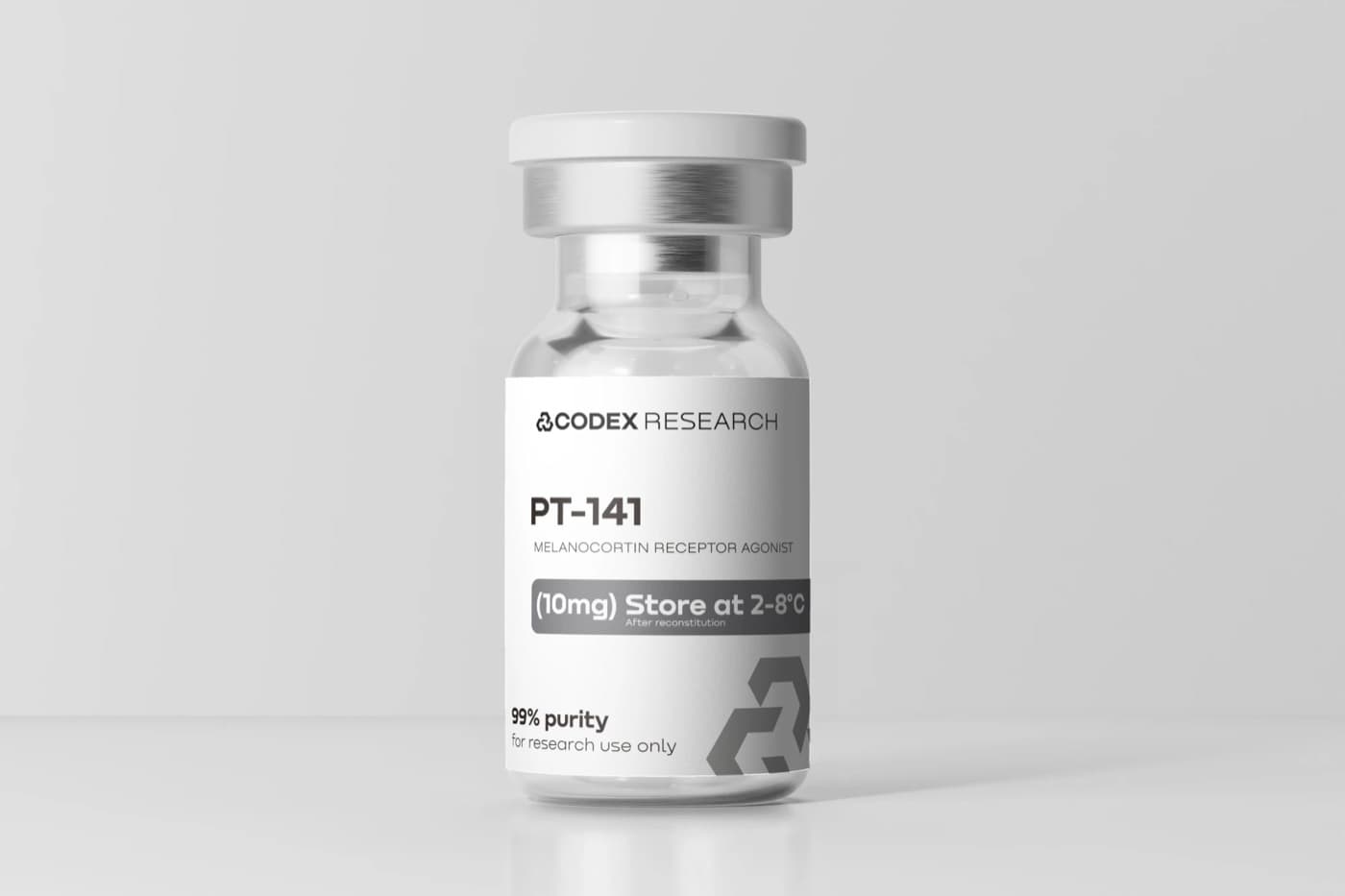
PT-141 is the research name for bremelanotide, a synthetic peptide that activates melanocortin receptors in the brain. As Vyleesi, it is FDA-approved for one form of low sexual desire in premenopausal women; products sold as "PT-141" are not that approved drug.
PT-141, now known by its generic name bremelanotide, is a small ring-shaped (cyclic) peptide of seven amino acids. It is a synthetic analogue of alpha-melanocyte-stimulating hormone and activates two melanocortin receptors in the brain, MC3R and MC4R (Diamond 2006). It does not act on blood flow to the genitals in the way that drugs such as sildenafil do; its proposed effect is on desire, through the brain.
It was developed by the US company Palatin Technologies. The first human studies, in the early 2000s, tested it as a nasal spray and as an injection in men with erectile dysfunction (Diamond 2004; Rosen 2004). Development then moved to women: a small laboratory study, a phase 2b dose-finding trial with an under-the-skin injection (Clayton 2016), and two phase 3 trials known as RECONNECT (Kingsberg 2019). On 21 June 2019 the FDA approved it as Vyleesi, an autoinjector, for premenopausal women with acquired, generalised hypoactive sexual desire disorder (HSDD).
Almost every clinical study was designed, funded or co-authored by the companies developing the drug (Palatin and, later, AMAG Pharmaceuticals). An independent re-analysis of the phase 3 data agreed on the size of the benefit but argued that it is small and that dropouts due to side effects were underreported (Spielmans 2021).
Studied for: low sexual desire in premenopausal women; earlier, erectile dysfunction in men.
Strongest evidence: two phase 3 randomised placebo-controlled trials in 1,267 women, plus a 52-week open-label extension.
Legal status: FDA-approved as Vyleesi for one indication in women. Not approved for men or for any other use.
02
PT-141 dosing in the FDA label
The approved drug has an official dosing schedule in its FDA label. It is shown here as published, with its source.
Dosing from the current FDA-approved label of each drug.
Drug
Approved use
Dosing in the label
Vyleesi (bremelanotide autoinjector)
Acquired, generalized low sexual desire (HSDD) in premenopausal women
1.75 mg under the skin of the abdomen or thigh, as needed, at least 45 minutes before expected sexual activity. No more than one dose in 24 hours; more than 8 doses a month is not recommended. Stopped after 8 weeks if there is no improvement.
Schedules reported for this peptide, with the syringe measure for each step and the supplies each one takes. Reported use is not evidence that a schedule works or is safe, and none of this is medical advice.
Gradual, once daily
Subcutaneous injection, once a day
Community-reported
Reported in the research community. It has not been tested as a schedule in human trials. Worked out with a 10 mg vial + 3 mL bacteriostatic water (3.33 mg/mL, 33.3 mcg per unit).
Amounts as reported, with the syringe or spray measure for the vial below. Not a recommendation.
Period
Amount each time
U-100 units
Volume
Weeks 1-8
500 mcg
15
0.15 mL
Weeks 9-12
1 mg
30
0.3 mL
Week 13 on
1.5 mg
45
0.45 mL
Minimum supplies, worked out from the amounts above. Add a margin for losses.
Item
8 weeks
12 weeks
16 weeks
Injections
56
84
112
Total peptide
28 mg
56 mg
98 mg
PT-141 vials (10 mg)
3
6
10
Bacteriostatic water
9 mL
18 mL
30 mL
Water bottles (10 mL)
1
2
3
U-100 insulin syringes
56
84
112
Alcohol swabs (boxes of 100)
112 (2)
168 (2)
224 (3)
04
PT-141 doses used in studies
The dose each published study gave its participants, copied from the paper. Not dosing instructions; animal doses do not convert directly to people.
At a glance: 8 studies report a dose (7 in people, 1 in animals).
Doses used in human studies
Kingsberg SA 2019: 1.75 mg as needed before anticipated sexual activity (Subcutaneous autoinjector, as needed; 24 weeks)
Diamond LE 2004: Range of single intranasal doses; erectile responses were significant at doses above 7 mg. Full dose range not given in the abstract; see the paper (Intranasal, single doses)
Rosen RC 2004: 0.3 to 10 mg in healthy men; placebo, 4 mg or 6 mg in a crossover design in men with erectile dysfunction (Subcutaneous, single doses)
Diamond LE 2006: 20 mg single intranasal dose, or placebo, in a double-blind crossover design (Intranasal, single dose; Two in-clinic sessions, with responses recorded over the following 24 hours)
Clayton AH 2016: 0.75 mg, 1.25 mg or 1.75 mg, or placebo, self-administered as desired (Subcutaneous, self-administered as desired; 12 weeks)
White WB 2017: 0.75 mg, 1.25 mg or 1.75 mg, or placebo (Subcutaneous)
Every study
Doses as reported by each study. Not a recommendation.
What has been studied, by type of evidence. A result in animals or cells is a reason to study something in people, not proof that it works in people.
In humans
Summarised
Bremelanotide has more human data than most peptides on this site, because it went through a full drug development programme. The main studies:
Early studies in men: as a nasal spray in healthy men and men with erectile dysfunction, doses above 7 mg produced erections measured by a device, starting about 30 minutes after dosing; flushing and nausea were the most common side effects (Diamond 2004). An injected form produced erections in men who had not responded well to sildenafil (Rosen 2004). It was never approved for men.
First study in women: in 18 premenopausal women with sexual arousal disorder, a single 20 mg nasal dose increased the number who reported moderate or high desire compared with placebo, but did not change measured genital blood flow (Diamond 2006).
Phase 2b dose-finding trial: 327 women used 0.75, 1.25 or 1.75 mg injections or placebo as desired for 12 weeks. The two higher doses together increased satisfying sexual events by 0.7 per month versus 0.2 with placebo, and improved desire and distress scores (Clayton 2016).
Phase 3 trials (RECONNECT): two 24-week trials in 1,267 premenopausal women with HSDD found that 1.75 mg as needed improved desire and reduced distress compared with placebo. These are the basis of the FDA approval (Kingsberg 2019).
Long-term extension: 684 women continued in a 52-week open-label phase; 272 completed it. No new safety signals were reported, and improvements in desire scores were maintained in those who stayed (Simon 2019).
Blood pressure study: ambulatory monitoring in 397 women showed small, short-lived rises in blood pressure and falls in heart rate after dosing (White 2017).
Pooled safety review: across 43 studies and about 3,500 people, nausea, flushing and headache were the most common side effects (Clayton 2022).
Verdict: in premenopausal women with HSDD, bremelanotide produced a statistically clear but modest improvement in desire and distress scores compared with placebo, at the cost of frequent nausea. Most of the evidence comes from the developers, and an independent re-analysis questioned how meaningful the benefit is (Spielmans 2021). There is no comparable evidence for men, for postmenopausal women, or for any other use.
In animals
Summarised
Sexual behaviour in female rats
In female rats, PT-141 increased solicitation, the behaviours a female uses to invite mating, without changing reflex responses, pacing or general movement (Pfaus 2004). This was the main animal finding behind testing it for low desire in women. The study was co-authored by Palatin scientists.
In cells (in vitro)
Nothing yet
No summary in our library yet. We only publish one after checking it against the original papers.
Proposed mechanisms from cell and animal studies. A plausible mechanism is not evidence of an effect in people.
Bremelanotide is thought to act in the brain rather than on the genitals. The supporting findings:
Melanocortin receptors: it activates MC3R and MC4R, receptors involved in appetite, sexual behaviour and other functions (Diamond 2006).
Desire rather than reflexes: in female rats it increased behaviours linked to sexual motivation but not reflexive sexual responses, which points to a central effect (Pfaus 2004).
No measurable change in genital blood flow: in women, a single dose did not change vaginal blood flow during erotic videos, even though desire ratings rose (Diamond 2006).
Blood pressure: drugs that activate MC4R may raise blood pressure, which is the proposed reason for the small rises seen after dosing (White 2017).
07
Reconstitution
How concentration changes with the amount of liquid added. A U-100 insulin syringe holds 1 mL in 100 units, so each unit is 0.01 mL. Step-by-step guide.
Step by step
Wash your hands and work on a clean, uncluttered surface. Let a refrigerated vial reach room temperature so the stopper is easier to pierce.
Wipe the rubber stopper of the peptide vial and of the bacteriostatic water with a fresh alcohol swab, and let them air-dry.
Draw the chosen volume of bacteriostatic water into a sterile syringe. With 2 mL, a 10 mg vial ends up at 5,000 mcg/mL, or 50 mcg per U-100 unit.
Insert the needle through the stopper and let the water run slowly down the inside wall of the vial, not straight onto the powder.
Swirl or roll the vial gently until the powder dissolves. Do not shake it: foaming can damage some peptides.
Check the solution against the light. It should be clear; cloudiness or particles mean something is wrong with the vial or the water.
Write the date and the volume of water on the label. Every unit calculation later depends on that volume.
Store the reconstituted PT-141 vial in the refrigerator, away from light.
Concentration by volume
A 10 mg vial: concentration after adding the liquid, and how much peptide each U-100 unit (0.01 mL) holds.
Arithmetic only. It assumes the vial holds exactly what the label says.
Concentration
5,000 mcg/mL
Per U-100 unit
50 mcg
Volume for your amount
—
08
Measuring with a U-100 syringe
What each mark on an insulin syringe holds once the vial is mixed. This is arithmetic, not a dose.
Reading a U-100 syringe: how much peptide each mark holds in a 10 mg vial mixed with 2 mL. Not a dose.
Syringe mark
Volume
Peptide in that volume
5 units
0.05 mL
250 mcg
10 units
0.1 mL
500 mcg
20 units
0.2 mL
1 mg
25 units
0.25 mL
1.25 mg
50 units
0.5 mL
2.5 mg
100 units
1 mL
5 mg
A U-100 insulin syringe holds 1 mL in 100 units, so each unit is 0.01 mL. The marks measure volume, not peptide.
Syringes come in 0.3 mL (30 units), 0.5 mL (50 units) and 1 mL (100 units) sizes. The smaller ones have finer marks and are easier to read for small volumes.
Read the volume at the top edge of the plunger's rubber seal, at eye level.
Tap out air bubbles before reading: a bubble takes up volume and makes the reading wrong.
Use a new sterile syringe and needle every time, and dispose of them in a sharps container.
09
Supplies
What reconstituting and measuring a vial takes.
The peptide vial, with its certificate of analysis (COA) for that batch. See how to read a COA.
Bacteriostatic water (water with 0.9% benzyl alcohol), which keeps a multi-use vial from growing bacteria. Sterile water has no preservative.
Sterile syringes to add the water, and U-100 insulin syringes to measure.
Alcohol swabs for the stoppers.
A sharps container for used needles.
A label or marker to write the date and the volume of water on the vial.
10
Side effects, safety and legal status
Because it is an approved drug, bremelanotide's side effects are better documented than those of most peptides. In the double-blind phase 3 trials, side effects were common and were the main reason people stopped (Clayton 2022). The FDA prescribing information lists uncontrolled high blood pressure and known cardiovascular disease as reasons not to use it.
Nausea, flushing and headache: nausea affected 40.0% on bremelanotide versus 1.3% on placebo, flushing 20.3% versus 1.3%, and headache 11.3% versus 1.9% (Clayton 2022). An independent analysis found that the odds of dropping out because of side effects were about 12 times higher on the drug than on placebo (Spielmans 2021).
Blood pressure and heart rate: systolic blood pressure rose by about 2 to 3 mmHg compared with placebo in the hours after a dose, with a fall in heart rate; peaks usually lasted under 15 minutes (White 2017).
Skin darkening (focal hyperpigmentation): rare at the doses used in the phase 3 trials, but it occurred in more than a third of people given up to 16 daily doses in a row (Clayton 2022). The FDA label notes it can affect the face, gums and breasts, is more likely with darker skin and daily dosing, and did not always resolve.
Drug interactions: it lowered blood levels of the painkiller indomethacin and of naltrexone, a medicine used for alcohol and opioid dependence (Clayton 2022).
Product quality: products sold online as "PT-141" are not Vyleesi. No regulator checks their identity, purity, dose or sterility, and none of the trial results above apply to them automatically.
Sport: we could not find bremelanotide named on the 2026 WADA Prohibited List. That list is not exhaustive, so athletes should check with their anti-doping organisation.
FDA
FDA-approved as Vyleesi (bremelanotide) for one indication. Products sold as "PT-141" for research are not the approved drug.
Status checked on
Oct 26, 2026
11
Storing PT-141
Before mixing
Freeze-dried (lyophilised) peptide is the most stable form. It is usually kept refrigerated, or frozen for long storage, sealed and away from light.
Heat, moisture and light speed up degradation. Keep the vial in its box and avoid leaving it in a car or by a window.
After mixing
Keep the reconstituted vial refrigerated and away from light. Do not freeze it again: freezing and thawing a solution can break the peptide down.
How long a mixed vial stays good depends on the peptide and the diluent, and for most research peptides there is no published stability data. Follow the supplier's guidance and discard any vial that turns cloudy.
Pierce the stopper as few times as possible, and always with a new sterile needle after wiping it with alcohol.
Write the volume of water on the label (for example "2 mL"). Without it, the unit calculations cannot be checked later.
12
Questions about PT-141
Is PT-141 FDA-approved?
FDA-approved as Vyleesi (bremelanotide) for one indication. Products sold as "PT-141" for research are not the approved drug.
What is the approved dose of PT-141?
The FDA label of each approved drug sets its dosing; section 02 shows it with the source. It applies to the prescription drug used as prescribed, not to research products.
What doses of PT-141 have been studied?
Our library has 10 studies on PT-141. The doses each one used are in section 04, next to the study. They are not dosing instructions.
How much PT-141 is in each syringe unit?
It depends on how much liquid is added to the vial. For a 10 mg vial with 2 mL, each U-100 unit holds 50 mcg. The reconstitution table and calculator work it out for other volumes.
Is PT-141 the same as Vyleesi?
They share the same active molecule, bremelanotide. Vyleesi is the FDA-approved product, made under regulated conditions and tested in clinical trials. Products sold online as PT-141 are not checked by any regulator, so their contents and purity are unknown.
Was PT-141 studied in men?
Yes. The first human studies, in the early 2000s, were in healthy men and men with erectile dysfunction, and reported erections after dosing. Development in men did not continue to approval, and the drug is approved only for premenopausal women with acquired, generalised HSDD.
Why do some sources cite a 2008 trial in women that this page does not?
A 2008 trial of bremelanotide in women with arousal disorder, published in the Journal of Sexual Medicine, has been retracted, and a 2008 trial in men by the same lead author carries an expression of concern from the Journal of Urology. We do not use either as evidence.
How large is the benefit in the approved use?
In the phase 3 trials, desire and distress scores improved more with bremelanotide than with placebo, but the average difference was modest. Supporters and critics agree on the numbers and disagree on how meaningful they are for patients.
How much bacteriostatic water goes into a 10 mg PT-141 vial?
There is no single correct volume: it only changes the concentration. For a 10 mg vial, 1 mL gives 10,000 mcg/mL, 2 mL gives 5,000 mcg/mL, 3 mL gives 3,333 mcg/mL. More water makes small amounts easier to measure; less water keeps volumes small. Whatever volume is used, write it on the label.
What does one unit on an insulin syringe mean?
On a U-100 syringe, 100 units = 1 mL, so one unit is 0.01 mL. How much peptide that holds depends on the concentration of the vial, which depends on how much water was added.
Can doses from animal studies of PT-141 be converted to people?
No. Animal doses are reported per kilogram for a different species, and scaling them to people is not reliable. That is why Upzo shows each study dose next to its study, unconverted.
How should PT-141 be stored?
Unopened freeze-dried vials are usually kept refrigerated and away from light. Once mixed, keep the vial refrigerated and follow the supplier's guidance on how long it lasts.
13
References
Bremelanotide for the Treatment of Hypoactive Sexual Desire Disorder: Two Randomized Phase 3 Trials. Kingsberg SA, Clayton AH, Portman D, et al. Obstetrics & Gynecology. 2019;134:899-908. doi:10.1097/AOG.0000000000003500
Double-blind, placebo-controlled evaluation of the safety, pharmacokinetic properties and pharmacodynamic effects of intranasal PT-141, a melanocortin receptor agonist, in healthy males and patients with mild-to-moderate erectile dysfunction. Diamond LE, Earle DC, Rosen RC, et al. International Journal of Impotence Research. 2004;16:51-59. doi:10.1038/sj.ijir.3901139
Evaluation of the safety, pharmacokinetics and pharmacodynamic effects of subcutaneously administered PT-141, a melanocortin receptor agonist, in healthy male subjects and in patients with an inadequate response to Viagra. Rosen RC, Diamond LE, Earle DC, et al. International Journal of Impotence Research. 2004;16:135-142. doi:10.1038/sj.ijir.3901200
An effect on the subjective sexual response in premenopausal women with sexual arousal disorder by bremelanotide (PT-141), a melanocortin receptor agonist. Diamond LE, Earle DC, Heiman JR, et al. Journal of Sexual Medicine. 2006;3:628-638. doi:10.1111/j.1743-6109.2006.00268.x
Bremelanotide for female sexual dysfunctions in premenopausal women: a randomized, placebo-controlled dose-finding trial. Clayton AH, Althof SE, Kingsberg S, et al. Women's Health. 2016;12:325-337. doi:10.2217/whe-2016-0018
Long-Term Safety and Efficacy of Bremelanotide for Hypoactive Sexual Desire Disorder. Simon JA, Kingsberg SA, Portman D, et al. Obstetrics & Gynecology. 2019;134:909-917. doi:10.1097/AOG.0000000000003514
Usefulness of ambulatory blood pressure monitoring to assess the melanocortin receptor agonist bremelanotide. White WB, Myers MG, Jordan R, et al. Journal of Hypertension. 2017;35:761-768. doi:10.1097/HJH.0000000000001221
Safety Profile of Bremelanotide Across the Clinical Development Program. Clayton AH, Kingsberg SA, Portman D, et al. Journal of Women's Health. 2022;31:171-182. doi:10.1089/jwh.2021.0191
Re-Analyzing Phase III Bremelanotide Trials for "Hypoactive Sexual Desire Disorder" in Women. Spielmans GI. Journal of Sex Research. 2021;58:1085-1105. doi:10.1080/00224499.2021.1885601
Selective facilitation of sexual solicitation in the female rat by a melanocortin receptor agonist. Pfaus JG, Shadiack A, Van Soest T, et al. Proceedings of the National Academy of Sciences of the United States of America. 2004;101:10201-10204. doi:10.1073/pnas.0400491101
Research supplier
For laboratory research use only.
Codex Research LabShips from Panama City · US domestic shipping
Research and education only. Not medical advice. Many peptides on this site are not approved by the FDA for human use. Doses shown are the ones used in published studies and are not a recommendation. Talk to a licensed clinician before using any of them. Read the full disclaimer.