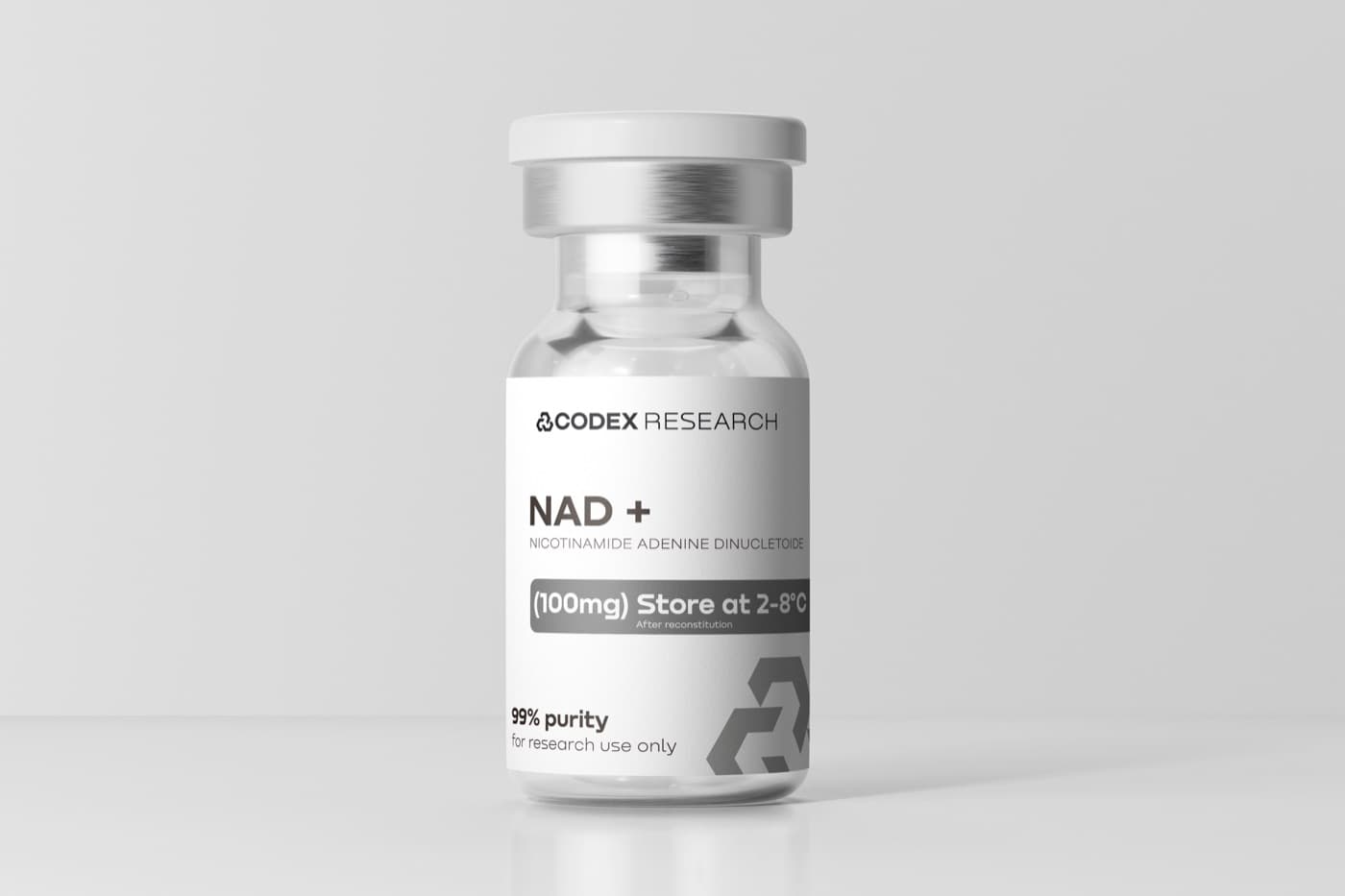
NAD+ is a coenzyme found in every cell and used in energy metabolism; it is not a peptide, but it is sold alongside them, often as an injection or IV drip. Almost all human trials use oral precursors (NR or NMN) rather than NAD+ itself, and injectable NAD+ is not FDA-approved.
Not FDA-approved
Human trials
Also known as Nicotinamide adenine dinucleotide, NAD
NAD+ (nicotinamide adenine dinucleotide) is a small molecule, not a peptide. Every cell uses it to move electrons during energy production, and enzymes such as sirtuins and PARPs consume it to control repair and signalling. The body builds it from vitamin B3 forms and recycles it constantly. Animal studies found that NAD+ falls with age in several tissues, which led to the idea of "NAD-boosting" (Rajman 2018).
Two very different things are sold under this idea, and the evidence for them is not the same. NAD+ itself is given by intravenous drip or injection, mostly in wellness clinics; it has very little published human research. Precursors, mainly nicotinamide riboside (NR) and nicotinamide mononucleotide (NMN), are taken by mouth and converted to NAD+ in the body; these have dozens of human trials. On this page we mark each study as NAD+ itself or a precursor. Precursor results cannot be assumed to apply to injected NAD+.
A 2026 systematic review of 113 studies found no outcome trials of intravenous or intramuscular NAD+ for anti-ageing or wellness; oral precursors raised NAD-related levels in blood but had mixed, often null, effects on health measures (Gallagher 2026).
Type: coenzyme (not a peptide). Precursors NR and NMN are forms of vitamin B3.
Studied for: ageing, metabolism and insulin sensitivity, muscle, Parkinson's disease.
Strongest evidence: small randomised trials of oral precursors. For NAD+ itself, only two tiny human reports on infusions.
Legal status: injectable NAD+ is not an FDA-approved drug.
02
NAD+ protocols and supplies
Schedules reported for this peptide, with the syringe measure for each step and the supplies each one takes. Reported use is not evidence that a schedule works or is safe, and none of this is medical advice.
Gradual, once daily
Subcutaneous injection, once a day
Community-reported
Reported in the research community. It has not been tested as a schedule in human trials. Worked out with a 1,000 mg vial + 3 mL bacteriostatic water (333 mg/mL, 3.33 mg per unit).
Amounts as reported, with the syringe or spray measure for the vial below. Not a recommendation.
Period
Amount each time
U-100 units
Volume
Week 1
50 mg
15
0.15 mL
Week 2
75 mg
22.5
0.23 mL
Week 3 on
100 mg
30
0.3 mL
Minimum supplies, worked out from the amounts above. Add a margin for losses.
Item
8 weeks
12 weeks
16 weeks
Injections
56
84
112
Total peptide
5,075 mg
7,875 mg
10,675 mg
NAD+ vials (1,000 mg)
6
8
11
Bacteriostatic water
18 mL
24 mL
33 mL
Water bottles (10 mL)
2
3
4
U-100 insulin syringes
56
84
112
Alcohol swabs (boxes of 100)
112 (2)
168 (2)
224 (3)
03
NAD+ doses used in studies
The dose each published study gave its participants, copied from the paper. Not dosing instructions; animal doses do not convert directly to people.
At a glance: 8 studies report a dose (7 in people, 1 in animals).
Doses used in human studies
Grant R 2019: 750 mg NAD+ in saline (3 µmol/min) vs saline (dose from the full text) (Intravenous infusion over 6 hours; Single 6-hour infusion, samples up to 8 hours)
Reyna K 2026: 500 mg NAD+ IV or 500 mg NR IV on four consecutive days (Intravenous infusion; 4 days, with 30 days of follow-up)
Martens CR 2018: 1,000 mg per day of nicotinamide riboside (from the full text) (Oral; 6 weeks on each arm of a crossover)
Elhassan YS 2019: 1 g NR per day (Oral; 21 days on each arm of a crossover)
What has been studied, by type of evidence. A result in animals or cells is a reason to study something in people, not proof that it works in people.
In humans
Summarised
NAD+ itself (intravenous)
Pilot infusion study: 8 healthy men received 750 mg NAD+ over 6 hours (3 received saline). Blood NAD+ did not rise for the first 2 hours, showing infused NAD+ is cleared or broken down fast; no adverse events were seen (Grant 2019).
Clinic records: in 6 clients given 500 mg IV NAD+ on four days, all reported moderate to severe gut symptoms, faster heart rate or chest pressure during the drip, and infusions took much longer; 8 clients given IV NR had milder symptoms (Reyna 2026).
Precursors taken by mouth (NR and NMN)
NR in healthy older adults: 1,000 mg a day for 6 weeks was well tolerated and raised NAD+ metabolism (Martens 2018).
NR in older men's muscle: raised NAD-related molecules in muscle and lowered some inflammatory markers, without changing mitochondrial energy output (Elhassan 2019).
NR in men with obesity: 12 weeks did not improve insulin sensitivity or body composition (Dollerup 2018).
NR in Parkinson's disease: raised brain NAD in some patients in a 30-person phase 1 trial, with exploratory signs of benefit (Brakedal 2022).
NMN in women with prediabetes: 10 weeks increased muscle insulin sensitivity in 13 women compared with placebo (Yoshino 2021).
Verdict: oral precursors reliably raise NAD-related levels and were well tolerated in trials lasting weeks to months, but effects on health outcomes are inconsistent. For injected or infused NAD+, there are no controlled outcome trials, and the little data available point to poor tolerability when given quickly.
In animals
Summarised
Ageing and metabolism (precursors)
In normal mice given NMN by mouth for 12 months, NMN was converted to NAD+ in tissues and was followed by less age-related weight gain and better energy metabolism, activity, insulin sensitivity and eye function (Mills 2016). Many other rodent studies report benefits, though results vary by model (Gallagher 2026). These are precursor studies; we found little animal work on injected NAD+ itself.
In cells (in vitro)
Nothing yet
No summary in our library yet. We only publish one after checking it against the original papers.
Proposed mechanisms from cell and animal studies. A plausible mechanism is not evidence of an effect in people.
NAD+ is a normal part of metabolism, so the question is not what it does but whether adding more from outside changes anything:
Energy metabolism and signalling: NAD+ carries electrons in energy production and is used up by enzymes that sense cell energy and repair DNA (Rajman 2018).
Precursors raise tissue levels: oral NR raised NAD-related molecules in older human muscle (Elhassan 2019) and in the brain of some people with Parkinson's disease (Brakedal 2022).
Infused NAD+ is broken down fast: during an IV infusion it disappeared from the blood and its breakdown products pointed to enzymes that split NAD+ (glycohydrolases and pyrophosphatases) (Grant 2019). Whether intact NAD+ reaches cells this way is unclear.
06
Reconstitution
How concentration changes with the amount of liquid added. A U-100 insulin syringe holds 1 mL in 100 units, so each unit is 0.01 mL. Step-by-step guide.
Step by step
Wash your hands and work on a clean, uncluttered surface. Let a refrigerated vial reach room temperature so the stopper is easier to pierce.
Wipe the rubber stopper of the peptide vial and of the bacteriostatic water with a fresh alcohol swab, and let them air-dry.
Draw the chosen volume of bacteriostatic water into a sterile syringe. With 2 mL, a 1,000 mg vial ends up at 500,000 mcg/mL, or 5 mg per U-100 unit.
Insert the needle through the stopper and let the water run slowly down the inside wall of the vial, not straight onto the powder.
Swirl or roll the vial gently until the powder dissolves. Do not shake it: foaming can damage some peptides.
Check the solution against the light. It should be clear; cloudiness or particles mean something is wrong with the vial or the water.
Write the date and the volume of water on the label. Every unit calculation later depends on that volume.
Store the reconstituted NAD+ vial in the refrigerator, away from light.
Concentration by volume
A 1,000 mg vial: concentration after adding the liquid, and how much peptide each U-100 unit (0.01 mL) holds.
Arithmetic only. It assumes the vial holds exactly what the label says.
Concentration
500,000 mcg/mL
Per U-100 unit
5,000 mcg
Volume for your amount
—
07
Measuring with a U-100 syringe
What each mark on an insulin syringe holds once the vial is mixed. This is arithmetic, not a dose.
Reading a U-100 syringe: how much peptide each mark holds in a 1,000 mg vial mixed with 2 mL. Not a dose.
Syringe mark
Volume
Peptide in that volume
5 units
0.05 mL
25 mg
10 units
0.1 mL
50 mg
20 units
0.2 mL
100 mg
25 units
0.25 mL
125 mg
50 units
0.5 mL
250 mg
100 units
1 mL
500 mg
A U-100 insulin syringe holds 1 mL in 100 units, so each unit is 0.01 mL. The marks measure volume, not peptide.
Syringes come in 0.3 mL (30 units), 0.5 mL (50 units) and 1 mL (100 units) sizes. The smaller ones have finer marks and are easier to read for small volumes.
Read the volume at the top edge of the plunger's rubber seal, at eye level.
Tap out air bubbles before reading: a bubble takes up volume and makes the reading wrong.
Use a new sterile syringe and needle every time, and dispose of them in a sharps container.
08
Supplies
What reconstituting and measuring a vial takes.
The peptide vial, with its certificate of analysis (COA) for that batch. See how to read a COA.
Bacteriostatic water (water with 0.9% benzyl alcohol), which keeps a multi-use vial from growing bacteria. Sterile water has no preservative.
Sterile syringes to add the water, and U-100 insulin syringes to measure.
Alcohol swabs for the stoppers.
A sharps container for used needles.
A label or marker to write the date and the volume of water on the vial.
09
Side effects, safety and legal status
For oral NR and NMN, trials of weeks to months reported good tolerability (Dollerup 2018; Gallagher 2026). For IV NAD+, the available reports describe uncomfortable symptoms during infusion, and there are no long-term safety data.
Infusion reactions: cramping, nausea, vomiting, diarrhoea, faster heart rate and chest pressure were reported with IV NAD+, stopping when the infusion ended (Reyna 2026).
Product quality: injectable NAD+ from wellness clinics or online sellers is not an FDA-approved drug, so identity, purity and sterility are not checked as they would be for an approved medicine.
Precursor data do not transfer: safety findings for oral NR or NMN do not show that injected NAD+ is equally tolerated.
Injection risks: any injected or infused product that is not sterile can cause infection.
FDA
Not FDA-approved as an injectable drug.
Status checked on
Oct 26, 2026
10
Storing NAD+
Before mixing
Freeze-dried (lyophilised) peptide is the most stable form. It is usually kept refrigerated, or frozen for long storage, sealed and away from light.
Heat, moisture and light speed up degradation. Keep the vial in its box and avoid leaving it in a car or by a window.
After mixing
Keep the reconstituted vial refrigerated and away from light. Do not freeze it again: freezing and thawing a solution can break the peptide down.
How long a mixed vial stays good depends on the peptide and the diluent, and for most research peptides there is no published stability data. Follow the supplier's guidance and discard any vial that turns cloudy.
Pierce the stopper as few times as possible, and always with a new sterile needle after wiping it with alcohol.
Write the volume of water on the label (for example "2 mL"). Without it, the unit calculations cannot be checked later.
11
Questions about NAD+
Is NAD+ FDA-approved?
Not FDA-approved as an injectable drug.
What doses of NAD+ have been studied?
Our library has 10 studies on NAD+. The doses each one used are in section 03, next to the study. They are not dosing instructions.
How much NAD+ is in each syringe unit?
It depends on how much liquid is added to the vial. For a 1,000 mg vial with 2 mL, each U-100 unit holds 5 mg. The reconstitution table and calculator work it out for other volumes.
Is NAD+ a peptide?
No. NAD+ is a coenzyme made of two nucleotides, not a chain of amino acids. It appears on peptide sites because it is often sold in the same vials and clinics.
Is IV NAD+ the same as taking NR or NMN?
No. NR and NMN are taken by mouth and converted to NAD+ inside the body, and most human trials use them. Infused NAD+ is broken down quickly in the blood, and there are no controlled outcome trials of it.
Why do NAD+ drips take so long?
In one clinic review, people given IV NAD+ reported gut symptoms, a faster heart rate or chest pressure during the drip, and NAD+ infusions averaged about 97 minutes versus 37 for nicotinamide riboside. The data come from a small retrospective study.
How much bacteriostatic water goes into a 1,000 mg NAD+ vial?
There is no single correct volume: it only changes the concentration. For a 1,000 mg vial, 1 mL gives 1,000,000 mcg/mL, 2 mL gives 500,000 mcg/mL, 3 mL gives 333,333 mcg/mL. More water makes small amounts easier to measure; less water keeps volumes small. Whatever volume is used, write it on the label.
What does one unit on an insulin syringe mean?
On a U-100 syringe, 100 units = 1 mL, so one unit is 0.01 mL. How much peptide that holds depends on the concentration of the vial, which depends on how much water was added.
Can doses from animal studies of NAD+ be converted to people?
No. Animal doses are reported per kilogram for a different species, and scaling them to people is not reliable. That is why Upzo shows each study dose next to its study, unconverted.
How should NAD+ be stored?
Unopened freeze-dried vials are usually kept refrigerated and away from light. Once mixed, keep the vial refrigerated and follow the supplier's guidance on how long it lasts.
12
References
A Pilot Study Investigating Changes in the Human Plasma and Urine NAD+ Metabolome During a 6 Hour Intravenous Infusion of NAD. Grant R, Berg J, Mestayer R, et al. Frontiers in Aging Neuroscience. 2019;11:257. doi:10.3389/fnagi.2019.00257
Intravenous infusion of nicotinamide adenine dinucleotide (NAD(+)) versus nicotinamide riboside (NR): a retrospective tolerability pilot study in a real-world setting. Reyna K, Heinzen G, Patel N, et al. Frontiers in Aging. 2026;7:1652582. doi:10.3389/fragi.2026.1652582
NAD⁺ supplementation for anti-aging and wellness: A PRISMA-guided systematic review of preclinical and clinical evidence. Gallagher C, Emmanuel OO. Ageing Research Reviews. 2026;116:103057. doi:10.1016/j.arr.2026.103057
Chronic nicotinamide riboside supplementation is well-tolerated and elevates NAD(+) in healthy middle-aged and older adults. Martens CR, Denman BA, Mazzo MR, et al. Nature Communications. 2018;9:1286. doi:10.1038/s41467-018-03421-7
Nicotinamide Riboside Augments the Aged Human Skeletal Muscle NAD(+) Metabolome and Induces Transcriptomic and Anti-inflammatory Signatures. Elhassan YS, Kluckova K, Fletcher RS, et al. Cell Reports. 2019;28:1717-1728.e6. doi:10.1016/j.celrep.2019.07.043
A randomized placebo-controlled clinical trial of nicotinamide riboside in obese men: safety, insulin-sensitivity, and lipid-mobilizing effects. Dollerup OL, Christensen B, Svart M, et al. American Journal of Clinical Nutrition. 2018;108:343-353. doi:10.1093/ajcn/nqy132
The NADPARK study: A randomized phase I trial of nicotinamide riboside supplementation in Parkinson's disease. Brakedal B, Dölle C, Riemer F, et al. Cell Metabolism. 2022;34:396-407.e6. doi:10.1016/j.cmet.2022.02.001
Nicotinamide mononucleotide increases muscle insulin sensitivity in prediabetic women. Yoshino M, Yoshino J, Kayser BD, et al. Science. 2021;372:1224-1229. doi:10.1126/science.abe9985
Long-Term Administration of Nicotinamide Mononucleotide Mitigates Age-Associated Physiological Decline in Mice. Mills KF, Yoshida S, Stein LR, et al. Cell Metabolism. 2016;24:795-806. doi:10.1016/j.cmet.2016.09.013
Therapeutic Potential of NAD-Boosting Molecules: The In Vivo Evidence. Rajman L, Chwalek K, Sinclair DA. Cell Metabolism. 2018;27:529-547. doi:10.1016/j.cmet.2018.02.011
Research supplier
For laboratory research use only.
Codex Research LabShips from Panama City · US domestic shipping
Research and education only. Not medical advice. Many peptides on this site are not approved by the FDA for human use. Doses shown are the ones used in published studies and are not a recommendation. Talk to a licensed clinician before using any of them. Read the full disclaimer.